For an ideal population policy
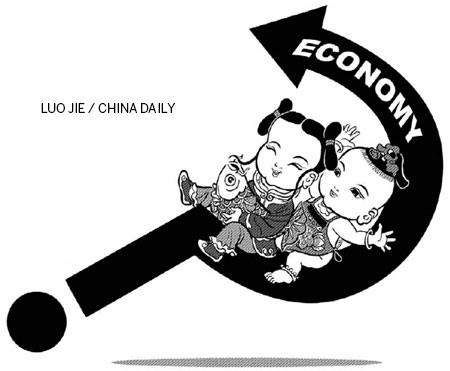
Expectations are high that China could relax the family planning policy that allows most couples to have only one child. According to senior officials from the National Health and Family Planning Commission, the government is reviewing the population policy and considering adjusting it "at an appropriate time".
The family planning policy was introduced in the late 1970s to slow the pace of population growth. Later, the government relaxed the policy and allowed couples in some rural areas to have a second child if the first was a girl. The government relaxed the rules again in the early 2000s and allowed couples - if both were from single-child families - to have a second child. Nevertheless, the big picture is that a large proportion of the population, particularly the majority of couples living in cities, still cannot have more than one child.
The policy has had a huge impact on China's demographic profile, with the most apparent being on the total fertility rate. The fertility rate, which measures the number of children born to an average woman and is a key driver of population change, has fallen to 1.6 compared with about 2.4 for other countries at the same level of development as China but without population controls. The current fertility rate is also well below the replacement level of 2.2, which would lead, other things being equal, to a stable population.
As a result, China is set to see a big drop in its population. In particular, the population of people between 15 and 59 years, the backbone of the workforce, is set to fall by about 7 percent by 2030, according to UN Population Division forecasts. Data from China's National Statistics Bureau show that last year the country's working age population fell for the first time in the modern era.
Concerns over the economic impact of a large fall in the workforce population appear to have triggered a shift in official thinking. Even if all couples might be able to have a second child from 2015, for now lifting all population control measures looks to have been ruled out.
Many people believe that the easing of the family planning policy will help boost the economy. But the economic impact of such a change will be much smaller than what they think because of three factors. First and most apparent is the fact that it will take at least 15 years (and more in many cases) for the children born under the new regulation to be old enough to join the workforce. Accordingly, increased fertility rates will not provide a solution to the worsening demographic outlook at least until the end of the next decade.
Second, it is not clear how many couples will choose to have a second child even if the restrictions are lifted. Couples living in cities, who will be the biggest beneficiaries of any change in the regulation, do not generally appear to want more children. Surging costs of housing and education, in particular, are likely to make families think twice before going in for a second child.
According to a recent survey, nearly half of urban residents want just one child. Their percentage is, in general, higher in more developed regions. Beijing and Shanghai, the most developed cities in China, are among those with the lowest fertility rates. This implies that as the rest of the country continues to develop and living standards increase further, more couples are likely to become less willing to have more than one child. In other words, even if the family planning policy is relaxed soon, the change will probably only slow the pace of the fall in the workforce population but will not be strong enough to turn the trend around.
Finally, growth in the workforce population has made only a small contribution to China's economic miracle. Although China's economic growth on average was 10 percent a year during the last two decades, the increase in the workforce added less than a percentage point to the annual growth. The rest of growth was the result of making workers more productive. The main reason why growth could slow in the coming decades is, therefore, not the shrinking labour force but the likely slowdown in productivity growth as the room to catch up with richer economies diminishes.
In the long run, easing of the family planning policy will be important to correct the distortions in China's demographics, such as the skewed gender ratio and aging population, which are undermining social stability. However, to sustain fast economic growth, it is more important that the government implement structural reforms to facilitate better allocations of resources and improve productivity.
The author is a Chinese economist at Capital Economics, a London-based independent macroeconomic research consultancy.
(China Daily 08/22/2013 page9)