Firms could help ease grads' woes
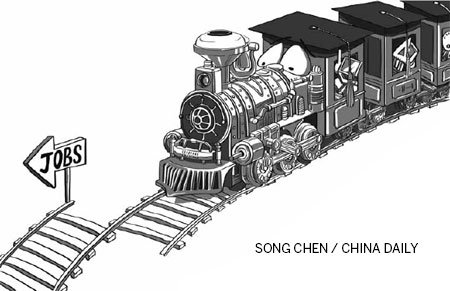
The inconsistency in the job market for college graduates could intensify and even lead to rising unemployment in urban China in the coming years. College graduates have been finding it increasingly difficult to get a job because of multiple factors, especially a mismatch between the national education structure and labor demand.
The number of graduates churned out by universities has increased from 1.6 million in 1999 to 7 million in 2013, representing an average annual growth of 11.83 percent, a figure higher than China's GDP growth rate.
Chinese people's faith in education, especially college education, has deepened after the government expanded the college admission scheme in 1999. Chinese families push their children to acquire higher education in the hope of giving them a brighter future. They believe a college degree is the least a youth requires to succeed in life. As a result, the number of college graduates jumped from 1.6 million in 1999 to 2.12 million in 2003, when the first batch of graduates emerged after the college expansion scheme, and hit 4.13 million in 2006.
But China's economy still relies, to a large extent, on manufacturing despite the fast growth in the service sector in the recent years. The manufacturing sector currently accounts for 45 percent of China's GDP and 30 percent of jobs. A survey of the labor market shows 103 major cities had 2.23 million job openings in the manufacturing sector, or 36.5 percent of total, in March 2013, compared with 0.93 million in 2006.
Job openings in State-owned enterprises have been quite steady over the past seven years -160,000 in 2007, 120,000 in 2008, 190,000 in 2011, 130,000 in 2010, 110,000 each in 2011 and 2012, and 130,000 in the first quarter of 2013.
The craze for higher education among today's youths has caused a structural mismatch in the labor market causing an oversupply of college graduates and shortage of vocational and technical school graduates. The supply of college graduates has been more than the demand for them in the job market since 2006. In contrast, the demand for vocational and technical school graduates has grown rapidly, and they have been in short supply since 2011.
The German industrial model is frequently used as an example of durable success because it has made the country the locomotive driving the eurozone in terms of exports and growth. The reason for Germany's success is the structure and dynamism of the so-called Mittelstand, made up of innovative small and medium-sized enterprises, which account for 50 percent of total private investment, 72 percent of private employment and 80 percent of all apprenticeships in the country.
The Mittelstand model also owes its success to factors such as a solid fiscal condition, export-oriented production structure, guarantee of quality, long-term relations with banks, financial conservativeness, involvement in local economic activities, social agreements between companies and employees, apprenticeship, and strong ties between companies and universities. These factors help increase productivity and foster innovation.
Some major education-related factors have also made the German model a success. The dual model of education that offers theoretical education as well as on-the-job vocational training has played a big role in the German model's success.
Early entrance into the job market helps many Germans build bright technical and industrial careers. In fact, a host of German business leaders have risen from the rank of interns to occupy top management positions. No wonder, youth unemployment is much lower in Germany compared with other European Union countries.
The fact that many companies reward their best interns and/or employees with scholarships to study engineering or earn a higher degree helps the managements to nurture as well as retain talents.
German companies do relocate low value-added activities to low-cost countries, but they keep the most innovative parts in Germany because keeping high value-added production in the country helps them develop better technology.
The continuous development of skills is a special feature of the German model, for which a company pays for most of the continuous training programs inside the plant. The strong industry-university ties create jobs for students and sow the seeds of innovation for companies. Since education and training are designed to meet the needs of companies, managements form clusters with universities to foster competitiveness.
The flexibility of employees and family culture plays a vital role in German companies' success. The Mittelstand has a continuity-based approach to employment. For example, during lean periods, or when production is low, employees get to keep their job but at the same time accept lower pay. And instead of wasting their free time, the employees use it to hone their skills and/or advance their technical and professional knowledge.
In other words, companies and their employees in Germany work like a family and cooperate to defend their interests.
Perhaps Chinese enterprises should give the German model a try, because it will not only help augment their performance and innovation capacity, but also improve the job prospects for graduates.
The author is head of research and chief economist of Haitong International Securities based in Hong Kong.
(China Daily 08/27/2013 page9)