When fallen corrupt officials confess in a Chinese court, they often repent having let their mind stray while in power, which they say has pushed them down the road to self-destruction.
Take Zhang Shuguang, a former top railways official charged with accepting 47.55 million yuan ($7.7 million) in bribes. On Sept 10 he admitted in court that after making some personal achievements, he turned to criminal activities as he "let his mind loose" and slackened in studies.
Interestingly, three months earlier, the former railways minister and his patron Liu Zhijun also blamed "slackening in studies and letting his guard down" for his downfall, before he was sentenced to death with a two-year reprieve for bribery and abuse of power.
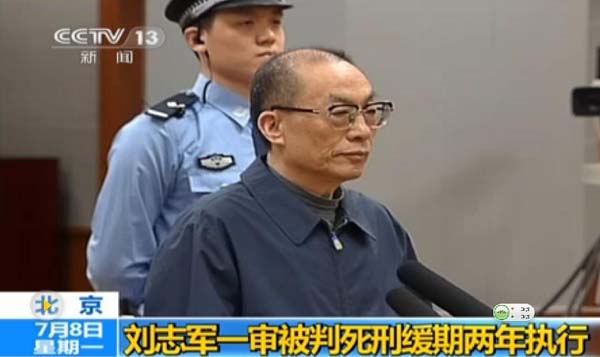
Video grab shows China's former Railway Minister Liu Zhijun on trial at the Beijing No. 2 Intermediate People's Court in Beijing, capital of China, July 8, 2013. [Photo/Xinhua]
You may brush aside such scripted excuses as hypocritical, desperate tactics aimed at being treated more leniently. But high moral standards of officials through incessant ideological indoctrination and self-study have long been a main anti-corruption strategy in China. So when a corrupt official is caught, a lack of moral education and reflection often becomes an easy excuse, while he carefully avoids other more important causes.
Now as corruption pervades the Chinese social fabric, the question is, has the education approach ever worked to prevent moral deviations by corrupt officials?
The answer seems to be yes, but with almost negligible effects, at least judging by a growing body of research results on what corrupt officials were thinking when they embarked on their dangerous path. Researchers have identified a number of psychological triggers that prompted officials to commit acts of corruption and fraud, in the context of low salaries, ample loopholes and a porous monitoring system.
In a recently concluded study on corruption that surveyed 103 fallen officials at the vice-minister level or higher, Tian Guoliang, a professor at the CPC's Central Party School, found five most common psychological factors: jealousy, peer pressure, compensation, risk-taking and superstition.
The once high-flyers were far less wealthy than well-off businesspeople, which caused an imbalance in their psyches. They followed suit and accepted bribes because their peers did. Some officials sought compensation because they thought they had worked hard but failed to benefit from their positions and were intent on taking anything they could get before they retired, with the protection of their own god, Tian says.
A new book, Psychology of Fallen Corrupt Officials, published by the CPC's Central Party School Publishing House, has summed up 10 common personality traits that prompted 300 Chinese officials to be corrupt. They included a strong need for power, greed, a need for instant gratification, jealousy, compensation, risk-taking, expectation of returns, and indulgence of children.
Some officials have more than one such trait, which made their corrupt behavior more aggressive and damaging, says the author, Liu Jizhou, a former anti-graft official.
Many experts on corruption now believe the strategy of moral education is an "immature idea", Liu writes, as he concludes that "self-centeredness and greed are two major weaknesses of humanity" and an effective enforcement of complete regulations to combat corruption is essential for Party officials to be clean.
Hopes are high for the government's pledge to set up a punitive and preventive system to ensure that people do not dare to, are not able to and cannot easily commit corruption. While tougher punishment is already meted out to fallen officials, other moves, such as more forceful surveillance and declaration of assets by officials, are expected to be in place sooner rather than later.
Then the corrupt officials may be reluctant to claim they have stolen millions from the public because they were simply too relaxed or had skipped political studies.
The author is editor-at-large of China Daily. dr.baiping@chinadaily.com.cn
(China Daily 09/24/2013 page8)
 New type of urbanization is in the details

Copyright 1995 - . All rights reserved. The content (including but not limited to text, photo, multimedia information, etc) published in this site belongs to China Daily Information Co (CDIC). Without written authorization from CDIC, such content shall not be republished or used in any form. Note: Browsers with 1024*768 or higher resolution are suggested for this site.
License for publishing multimedia online 0108263 Registration Number: 130349