Human rights are well protected in Tibet and Tibetans enjoy the benefits of social and economic programs
The Universal Periodic Review of the United Nations Human Rights Council will issue the second review of China's human rights record on Oct 22. After the first review, China's Ministry of Foreign Affairs took the lead in organizing working groups to give effect to the suggestions of the UN's top human rights body.
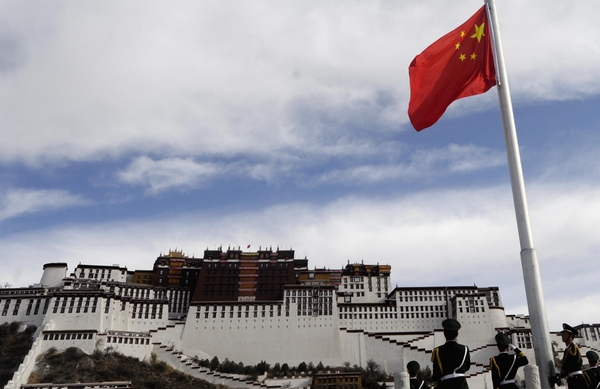
A flag-raising ceremony is held in front of the Potala Palace to mark the 54th anniversary of the abolishment of Tibet's feudal serfdom in Lhasa, capital of southwest China's Tibet autonomous region, March 28, 2013. Authorities have designated March 28 as the day to commemorate the 1959 democratic reform in Tibet, which ended the feudal serf system. The reform freed about 1 million Tibetans, over 90 percent of the region's population at the time, from a life of serfdom.[Photo/Xinhua]
About 20 non-governmental organizations and academic institutions were consulted and asked to contribute to the draft of China's human rights report, which was posted on the Ministry of Foreign Affairs' official website to solicit public opinions.
As an expert in Tibetology and human rights development in the Tibet autonomous region, I was among those asked to contribute to the draft report on China's human rights.
According to my observation, the term "human rights" was not part of the Tibetan language before 1959 when the democratic reform in Tibet began. Before 1959, Tibet was a society of feudalism and serfdom under theocratic rule. Under such a social system, more than 90 percent of the population was poor, oppressed, exploited and denied even the basic right to subsistence. Human rights, needless to say, was non-existent in such a society. For the serfs and slaves prior to the democratic reform, to live as a normal human being was only an unattainable dream.
It was only in the 1980s and early 1990s that the term "human rights" came to be used in the context of Tibet because that was when the West launched its so-called human rights diplomacy.
But some Westerners have been ignoring the violation of the rights of most Tibetans under feudalism and serfdom, which prevailed in the region before 1959, because their only aim is to accuse the central government of "harming" the culture, religion and freedom of expression of Tibetans. These Westerners have turned a blind eye to the well-being of Tibetans under the central government.
In fact, the central government and local authorities have gone to great lengths to develop agriculture and animal husbandry in Tibet, keeping in mind the tangible interests of Tibetans.
 New type of urbanization is in the details

Copyright 1995 - . All rights reserved. The content (including but not limited to text, photo, multimedia information, etc) published in this site belongs to China Daily Information Co (CDIC). Without written authorization from CDIC, such content shall not be republished or used in any form. Note: Browsers with 1024*768 or higher resolution are suggested for this site.
License for publishing multimedia online 0108263 Registration Number: 130349