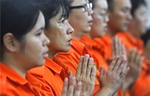
On Nov 15, 2013, the Third Plenum of the 18th Communist Party of China Central Committee issued its resolutions to implement a long list of comprehensive reforms. Among the reforms is the abolition of the controversial "re-education through labor" policy, abbreviated as laojiao in Chinese. The move has been hailed, both at home and abroad, as a milestone in the development of China's legal sector.
Formally established by a central government administrative regulation in 1957, laojiao is a special measure of administrative - rather than criminal - detention. Its purported aim is to punish those who commit offenses not serious enough to demand criminal punishment.
Laojiao has undergone significant changes over the years. The earlier lists of targets included politically unreliable individuals. Later, the spectrum of laojiao was expanded to tackle a number of social evils, such as drug addiction, prostitution and gambling. Most recently, so-called illegal petitioning was added to its list of offenses.
Laojiao is denial of liberty without trial. Sometimes the punishment is even harsher than that handed down by a court, because an offender could be detained in a laojiao center for up to three years with the possibility of a one-year extension. Officially, the decision on laojiao is supposed to be made by a committee comprising officials from government agencies for civil affairs, police and labor. In practice, however, police officials are the sole decision-makers.
Legal experts and human rights activists have long criticized the laojiao system on the grounds that it violates domestic as well as international laws.
Laojiao contravenes the Chinese Constitution, which requires the detention of a person to be approved by a court or a prosecuting authority. It is also a violation of China's Legislation Law and Administrative Penalty Law, both of which state that any restriction of personal freedom must be authorized by a national parliamentary law, not by an administrative regulation.
Moreover, laojiao is not compatible with international human rights standards, especially the right to liberty in Article 9 and the right to a fair trial in Article 14 of the International Covenant on Civil and Political Rights, which China has signed and is reportedly ready to ratify.
The high-profile cases of Tang Hui, a former laojiao inmate and mother of a rape victim, and Ren Jianyu, a former Chongqing village official confined for "spreading negative comments on Chongqing" show that the legal power exercised by police over laojiao is prone to be abused. Many commentators believe that laojiao has actually turned into a convenient tool for local authorities that use it in the name of maintaining social stability to retaliate against critics and troublemakers.
 New type of urbanization is in the details

Copyright 1995 - . All rights reserved. The content (including but not limited to text, photo, multimedia information, etc) published in this site belongs to China Daily Information Co (CDIC). Without written authorization from CDIC, such content shall not be republished or used in any form. Note: Browsers with 1024*768 or higher resolution are suggested for this site.
License for publishing multimedia online 0108263 Registration Number: 130349