|
|
Movie posters of Zhang Yimou's Red Sorghum, Tsai Ming-liang's The River and Wang Quan-an's Tuya's Marriage. Photo provided to China Daily |
Festival games
The festival circuit is a game with its own rules. Generally speaking, you have to present quality films, but that does not mean all good films have equal chances. There is decidedly an art-house sensibility to it, which varies slightly from festival to festival and from section to section. By sheer gravitas, the top three festivals in Europe (Cannes, Berlin and Venice) wield enormous influence in the rest of the world, especially the Chinese-speaking world, and selections and winners are endlessly parsed for clues about elements that may click with curators and juries.
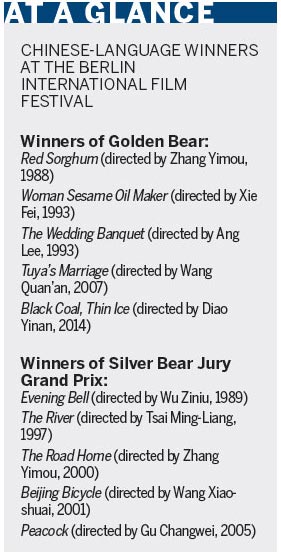
When Zhang Yimou's Red Sorghum won the first Golden Bear for a Chinese film, it marked the opening shot of the Fifth Generation on the world stage (even though a couple of other films such as The Yellow Earth had already made waves domestically). Because international festivals can bypass China's normal selection process, they have an advantage in spotting new talents and new trends. Filmmakers like Jia Zhangke and Wang Quan'an are beneficiaries of this outside force.
However, international recognition can also have the adverse impact of diverting attention and resources from areas of interest for mainstream Chinese audiences. When award winners eventually fail to find a reasonable audience at home, the awards themselves are increasingly seen as a stamp of elitist alienation from popular taste. This was especially poignant in Taiwan where festival favorites like Tsai Ming-liang have spawned imitators whose sole purpose is to win more awards and ignore the home market, thus losing it to foreign competition without even putting up a fight. The emergence of local hits, including Cape No 7, Monga and You Are the Apple of My Eye, none of which were made with any award hopes, is seen as a much needed correction.
The most abundant crop of global winners for the Chinese mainland appeared in the late 1980s and early 1990s, coinciding with the sharpest decline of Chinese cinema in attendance and box-office revenue. Though there was no causal effect in this case, it helped cement the public perception about the irrelevance of film festivals outside China in shaping the Chinese market. The fast expansion of this market in recent years, with a palpable absence of strong Chinese contenders on the festival circuit, serves to send a subtle message to film investors that you don't have to kowtow to "the 18 guys named Dieter in black turtlenecks" (in the words of Kaiser Kuo, founder and host of the Sinica podcast) to find success in the exploding China market.
The ripple effect of the win of Diao's film will be more accurately measured when it premieres domestically. How much of a box-office boost will be made as a result of the prestige and all the publicity that accompanies it? Will it attract a much larger audience than it otherwise would? Will it make the money back for its investors - maybe several times over? This will be scrutinized by many in the industry. To take a step back into the realm of critical reception, will it receive rave reviews from domestic cinephiles a la Red Sorghum or lukewarm ones like Tuya's Marriage, another Chinese work that nabbed the Golden Bear?
Assuming a reasonable turnout at the box office, Black Coal, Thin Ice may help highlight the diversity of Chinese cinema. Yes, the market is surging and genre movies are all the rage, but there is another front that focuses on artistic innovation. An individual filmmaker may choose one path, but a healthy film industry needs to develop in all directions. Without movies of mass appeal, winning kudos is just like the tip of the iceberg but with no iceberg underwater; and without artistic excellence, which festivals tend to endorse, the industry will be seen as nouveaux riches with no culture. Hopefully, from now on Chinese cinema will not sacrifice one for the other, but rather, have the two complement each other.
|
|
|
|
| Chinese film a hit at Berlin Festival | Chinese film 'Black Coal, Thin Ice' wins Golden Bear in 64th Berlinale |
Related:


Copyright 1995 - . All rights reserved. The content (including but not limited to text, photo, multimedia information, etc) published in this site belongs to China Daily Information Co (CDIC). Without written authorization from CDIC, such content shall not be republished or used in any form. Note: Browsers with 1024*768 or higher resolution are suggested for this site.
License for publishing multimedia online 0108263 Registration Number: 130349