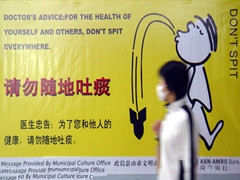
The ongoing annual sessions of the National People's Congress and Chinese People's Political Consultative Conference should work out measures to strengthen public transport security.
This is important because just days before the two sessions opened, a fire in a bus in Guiyang, Guizhou province, killed six passengers and injured 35. Local police say a suspect, who has been arrested, used gasoline to set fire to the bus to vent his fury over a family dispute. Similar incidents were reported from Xiamen, Fujian province, and Chengdu, Sichuan province, earlier. And last week two teenagers sprayed smelly gas in a Guangzhou subway "just for fun", triggering a small stampede.
Public transport security needs to be especially strengthened in cities with high population density such as Beijing and Shanghai, because buses and metro trains are crowded during office hours, and even a minor fire, let alone a major emergency, could put commuters in danger.
Singapore is a leader in urban transport management, and its experience may help Chinese cities strengthen public transport security. Singapore efficiently accommodates 5.30 million people in an area of 716 square kilometers, making it one of the world's densest cities. The city-state is well known for its livability and vibrancy, which can largely be attributed to its convenient, comfortable and secure mass transit system.
Singapore has adopted a two-pronged approach to manage transportation. On one hand, it depresses private car ownership and usage by Certificate of Entitlement, unitary vehicle and oil pricing, and Electronic Road Pricing, making car ownership an expensive proposition. Only 38.3 percent of Singaporean households own private cars, much lower than other developed countries with equivalent wealth. On the other hand, Singapore encourages public transport, and roughly 60 percent of its commuters use Mass Rapid Transit and public buses during morning peak time.
The Land Transport Authority, the public transport authority in Singapore, is responsible for maintaining public security. The LTA and public transit operators have adopted a wide range of measures to ensure public safety and security.
To enhance public transport security on buses and trains, and in stations, closed circuit television cameras are installed at all MRT stations and bus interchanges and periodic patrols are carried out.
Commuters ubiquitously use smart cards (for example, EZ-Link), which enable the operators to identify who is boarding and alighting where and when. The authorities also encourage the development of mobile phone apps to facilitate the use of public transport. The huge data gathered from these technologies are a powerful platform, and many modules and analytics can be developed to support various public transport security purposes.
Singapore is a "fine" country with severe fines and punishment. Commuters carrying dangerous goods in public vehicles, meddling with plant and equipment, or misusing emergency safety devices face a penalty of up to S$5,000 (US$3,942). Eating or drinking on board is strictly prohibited. There is no garbage can and toilet in MRT stations, since these containers may be misused to hide explosive or other threats.
Public transport security, however, is not solely the responsibility of the authorities and operators. Other agencies and actors should share the responsibility. Singapore set up the Public Transport Security Committee in 2004 to strengthen public transport security. Chaired by LTA's chief executive and composed of various government agencies and public transport operators, the PTSC is a cross-sectoral collaboration mechanism to facilitate these actors to work closely to secure the public transport system against security threats.
Everyone is responsible for public transit security. The broadcasts, posters and videos in MRT stations and bus interchanges frequently circulate public transport security knowledge and news, and commuters are encouraged to report suspicious articles or people to police officers or transport officials.
 New type of urbanization is in the details

Copyright 1995 - . All rights reserved. The content (including but not limited to text, photo, multimedia information, etc) published in this site belongs to China Daily Information Co (CDIC). Without written authorization from CDIC, such content shall not be republished or used in any form. Note: Browsers with 1024*768 or higher resolution are suggested for this site.
License for publishing multimedia online 0108263 Registration Number: 130349