|
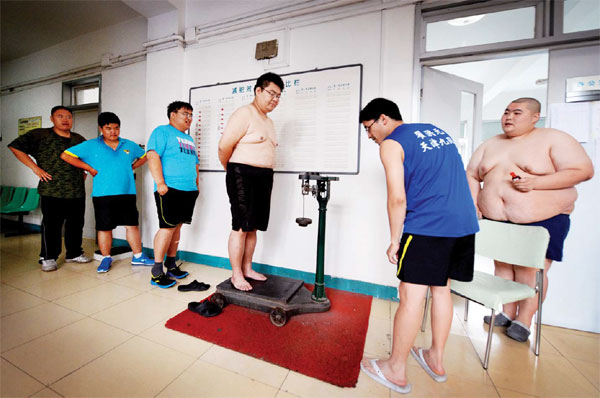 Overweight people line up to check their weight after their acupuncture and exercise treatment at a hospital in Tianjin, northern China. Obesity is a growing problem in China with 23 percent of Chinese males under 20 classified as overweight or obese. For females the figure is 14 percent. [Photo/AFP] |
Are sports galas like the Nanjing Youth Olympic Games, scheduled to open on Aug 16, inspiring events for Chinese youths? No, if we go strictly by the physical health of the youths.
It’s easy to blame the shortage of public playgrounds and other sports facilities — while spending huge amounts of money on hosting big sports events — for the sorry state of affairs. But the real blame for youths’ poor physical health should be shared by parents and schools.
For long, Chinese people were known for their slim physique. In fact, some of my colleagues say the word “obesity” was almost alien to them until newspapers first mentioned it as a problem in the late 1990s.
Fast food chains like McDonald’s and KFC opened their first outlets in China in the late 1980s, and within 25 years they have not only corrupted Chinese people’s taste buds but also helped them put on loads of weight. Take a peek into any fast food outlet and you’ll see several big, fat diners, who despite their bulk lack calcium and essential vitamins.
Vitamin D, for example, is provided only by sunshine and fish oil. But few Chinese children stay outdoors long enough to get the necessary amount of sunshine for their daily quota of vitamin D. Many children do not, or cannot, do so because they have loads of homework to do or have to attend extra classes, or simply because their overprotective parents won’t allow them to go outside.
Lack of outdoor activities impairs children’s social development too, for they end up knowing little about team spirit, competition, interpersonal relationships and mutual help.
A majority of Chinese students in general and almost 90 percent of those in students suffer from myopia, because they remain glued to books or computers for long hours on a regular basis to earn good scores in examinations. Physical inactivity makes them overweight, too.
A national report on food and health in 2009 showed that 12 million Chinese children were overweight. In other words, 7 percent of the world’s overweight children were in China. In 2007, 19.5 percent of primary and middle school children in Beijing were overweight, but by 2013, 20.7 percent of them were considered obese. Children in cities consume more fat than those in rural areas but engage in fewer physical activities to burn the excess fat.
Besides, it’s not rare to see Chinese parents criticize school officials if their children return home with even a small scratch on the hand or the leg, which in a way prevents schools from encouraging students to play sports.
Even though the government has been trying since 2010 to make physical education classes compulsory in schools, the 45-minute-a week period is often “borrowed” by teachers to complete the syllabi of “important” subjects. Also, there is dearth of physical education teachers in the country. To overcome such problems, the government has to use physical education as one of the criteria to judge students’ performance.
Thrifty or lavish, the Nanjing Youth Olympic Games is not preventing China from building sports facilities, so there is no reason to see it as a waste of money. Chinese children don’t play soccer not because there are not enough soccer fields but because sports is not considered important in either school or family education.
The criteria and rules for physical activities for students have been in place for a long time; the challenge is their implementation. Until there is a change in the country’s exam-oriented culture, the education system cannot transform into a dynamic system that helps students to develop their moral, psychological, intellectual, social, as well as physical aptitudes.
May the Nanjing Youth Olympic Games inspire Chinese youths, who are enjoying the summer vacation now, to move their bodies outdoors to get some sunshine and play some games.
The author is Canadian freelance writer.


Copyright 1995 - . All rights reserved. The content (including but not limited to text, photo, multimedia information, etc) published in this site belongs to China Daily Information Co (CDIC). Without written authorization from CDIC, such content shall not be republished or used in any form. Note: Browsers with 1024*768 or higher resolution are suggested for this site.
License for publishing multimedia online 0108263 Registration Number: 130349