 |
|
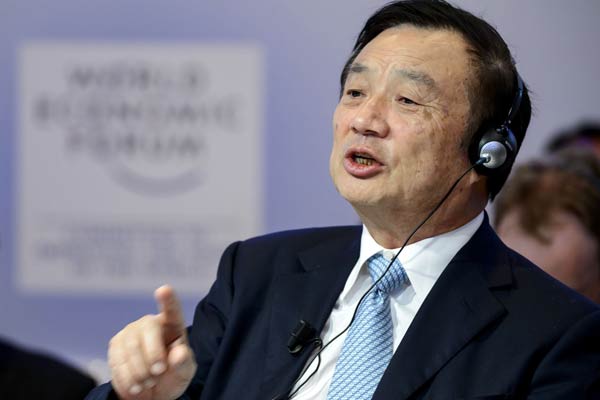
Huawei founder and president Ren Zhengfei speaks during a session of the World Economic Forum annual meeting on Thursday, in Davos. [Photo/Agencies] |
The compass, paper money, moveable type printing, gunpowder and silk. These are a few of the inventions that until the early modern era put China ahead of the West as an innovator. But past glories are insufficient to address current and future challenges. Innovation requires a continuous flow of new ideas, and the ability to transform these into dynamic economic processes.
What should China do to support its transition to a more innovative economy? Lessons from other countries point to three key steps.
The first is education. The success of advanced economies is without exception founded on strong and well-funded education systems. Basic education lays the foundation for other levels. It needs to be amply funded and accessible to all regions and social groups.
China currently spends 4 percent of GDP on education, which is lower than other middle-income countries. Developed economies generally spend 5 to 7 percent of GDP on education.
China has made enormous progress in educational development, and there are pockets of educational excellence, for example in Shanghai. To ensure that high-quality basic education is available throughout the country, including poor and remote areas, spending on education needs to increase further.
Pedagogical approaches lay the foundation for innovative thinking. China should move from rote-and exam-based learning to student-centered learning, with an emphasis on problem solving and creativity. The seeds for innovation are sown early.
Advanced economies have high-quality tertiary education systems that are independent and well resourced. China's higher education system has expanded rapidly, but quality improvements have not kept pace. In relation to its size and population, China still has relatively few top-tier universities.
Second, innovative economies spend a lot on research and development (R&D). China adopted a comprehensive R&D policy in 2006 and expects to spend 2.2 percent of GDP on R&D by 2015. This is higher than European economies' 2 percent but less than Singapore's 2.3 percent or South Korea's 4 percent.


I’ve lived in China for quite a considerable time including my graduate school years, travelled and worked in a few cities and still choose my destination taking into consideration the density of smog or PM2.5 particulate matter in the region.
Copyright 1995 - . All rights reserved. The content (including but not limited to text, photo, multimedia information, etc) published in this site belongs to China Daily Information Co (CDIC). Without written authorization from CDIC, such content shall not be republished or used in any form. Note: Browsers with 1024*768 or higher resolution are suggested for this site.
License for publishing multimedia online 0108263 Registration Number: 130349