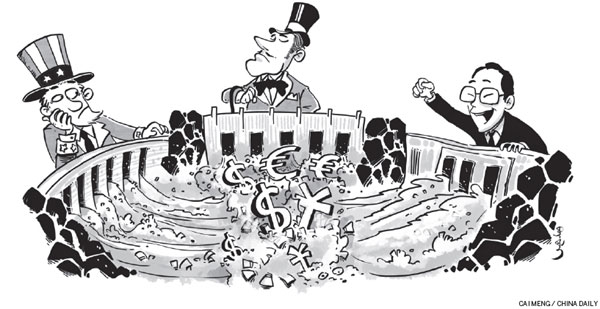
Predictably, the European Central Bank has joined the world's other major monetary authorities in the greatest experiment in the history of central banking. By now, the pattern is all too familiar. First, central banks take the conventional policy rate down to the dreaded "zero bound". Facing continued economic weakness, but having run out of conventional tools, they then embrace the unconventional approach of quantitative easing (QE).
The theory behind this strategy is simple: Unable to cut the price of credit further, central banks shift their focus to expanding its quantity. The implicit argument is that this move from price to quantity adjustments is the functional equivalent of additional monetary policy easing. Thus, even at the zero bound of nominal interest rates, it is argued, central banks still have weapons in their arsenal.
But are those weapons up to the task? For the ECB and the Bank of Japan, both of which are facing formidable downside risks to their economies and aggregate price levels, this is hardly an idle question. For the United States, where the ultimate consequences of QE remain to be seen, the answer is just as consequential.
In terms of transmission, the US Federal Reserve has focused on the so-called wealth effect. First, the balance sheet expansion of some $3.6 trillion since late 2008 - which far exceeded the $2.5 trillion in nominal GDP growth over the QE period - boosted asset markets. It was assumed that the improvement in investors' portfolio performance - reflected in a more than threefold rise in the S&P 500 from its crisis-induced low in March 2009 - would spur a burst of spending by increasingly wealthy consumers. The BOJ has used a similar justification for its own policy of quantitative and qualitative easing (QQE).
The ECB, however, will have a harder time making the case for wealth effects, largely because equity ownership by individuals (either direct or through their pension accounts) is far lower in Europe than in the US or Japan. For Europe, monetary policy seems more likely to be transmitted through banks, as well as through the currency channel, as a weaker euro - it has fallen some 15 percent against the US dollar over the last year - boosts exports.


I’ve lived in China for quite a considerable time including my graduate school years, travelled and worked in a few cities and still choose my destination taking into consideration the density of smog or PM2.5 particulate matter in the region.
Copyright 1995 - . All rights reserved. The content (including but not limited to text, photo, multimedia information, etc) published in this site belongs to China Daily Information Co (CDIC). Without written authorization from CDIC, such content shall not be republished or used in any form. Note: Browsers with 1024*768 or higher resolution are suggested for this site.
License for publishing multimedia online 0108263 Registration Number: 130349