 |
|
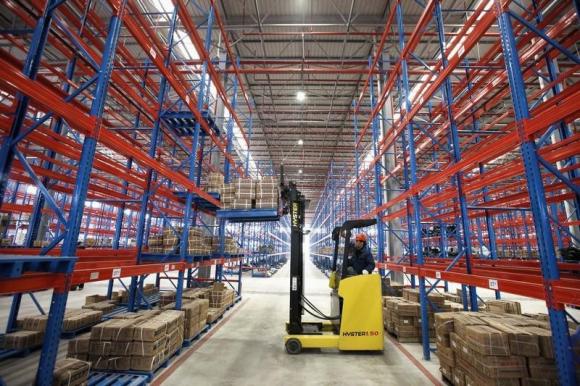
An employee works at a logistic center in Huaibei, Anhui province, Jan 20, 2015.[Photo/Agencies] |
After four disappointing years, Chinese economists have realized that slowing GDP growth - from a post-crisis peak of 12.8 percent in 2010 to about 7 percent today - is mainly structural, rather than cyclical. In other words, China's potential growth rate has settled onto a significantly lower plateau. While the country should be able to avoid a hard landing, its annual growth is likely to remain between 6 and 7 percent over the next decade. But this may not necessarily be bad news.
One might ask why GDP in China, whose per capita income recently surpassed $7,000, is set to grow so much more slowly than Japan's did from 1956 to 1970, when the Japanese economy, with per capita income starting from about $7,000, averaged 9.7 percent annual growth. The answer lies in potential growth.
Whereas, according to Japan's central bank, Japanese labor productivity grew by more than 10 percent a year, on average, from 1960 to 1973, China's productivity has been declining steadily in recent years, from 11.8 percent in 2001-2008 to 8.8 percent in 2008-2012, and to 7.4 percent in 2011-2012. Japan's labor supply (measured in labor hours) was also growing during that period by more than 3 percent a year. In contrast, China's working-age population has been shrinking by more than 3 million a year since 2012 - a trend that will, with a 4 to 6-year lag, cause the growth in labor supply to decline, and even turn negative.
Given the difficulty of reversing these trends, it is difficult to imagine how China could maintain a growth rate anywhere close to 10 percent for another decade despite its low per capita income. But there is more.
As Japanese economist Ryuichiro Tachi has said, Japan also benefited from a high savings rate and a low capital coefficient (the ratio of capital to output) of less than 1. Though a precise comparison is difficult, there is no doubt that China's capital coefficient is much higher, implying a larger gap between the growth rate of capital intensity (the total amount of capital needed per dollar of revenue) and that of labor productivity.
At times, a high investment rate can offset a high capital coefficient's negative impact on growth. But China's investment is already too high, accounting for almost half of GDP. With capital intensity increasing significantly faster than labor productivity in China, the inefficiency of investment is clear. In this context, increased investment would only exacerbate the problem.
Making matters worse, China's corporate debt is already the highest in the world, both in absolute terms and relative to GDP. In this context, increasing investment would not only reduce capital efficiency further; it would also heighten the risk implied by companies' high leverage ratios.
With all major indicators suggesting a significant decline in China's growth potential, China's leaders must accept the reality of lower growth and adjust their priorities accordingly. Succumbing to the temptation of massive monetary and fiscal stimulus, such as that pursued in the wake of the global financial crisis, would not only fail to boost growth in a sustainable way; it also would undermine growth and stability in the medium to long term. A better approach would focus on making economic growth more sustainable.
On this issue, Japan has some useful lessons to offer. In the 1970s, recognizing the inevitability of a slowdown, Japan shelved its ambitious plan to "remodel" the Japanese archipelago. Policymakers shut down energy-intensive factories in the heavy chemical industry, promoted innovation and took steps to address air and water pollution. As a result, the quality of Japan's economic growth improved considerably, even as its rate fell by nearly half in the decade after the oil shock in 1973.
For China, accepting lower growth provides a crucial opportunity to support stable and sustainable development. If China's leaders stay the course of reform and rebalancing, the entire global economy will be better off.
The author, a former president of China Society of World Economics, served on the Monetary Policy Committee of the People's Bank of China from 2004 to 2006.
Project Syndicate


I’ve lived in China for quite a considerable time including my graduate school years, travelled and worked in a few cities and still choose my destination taking into consideration the density of smog or PM2.5 particulate matter in the region.
Copyright 1995 - . All rights reserved. The content (including but not limited to text, photo, multimedia information, etc) published in this site belongs to China Daily Information Co (CDIC). Without written authorization from CDIC, such content shall not be republished or used in any form. Note: Browsers with 1024*768 or higher resolution are suggested for this site.
License for publishing multimedia online 0108263 Registration Number: 130349