 |
|
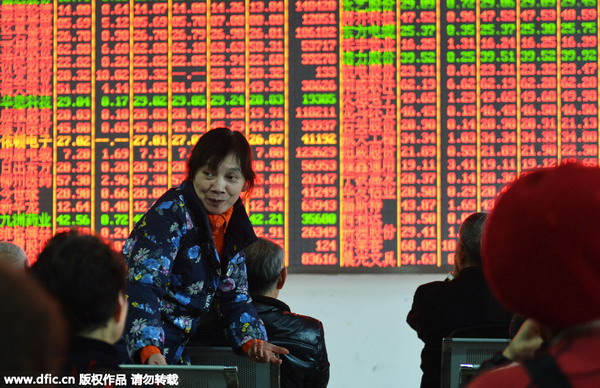
Chinese investors look at prices of shares (red for price rising and green for price falling) at a stock brokerage house in Hangzhou city, East China's Zhejiang province, March 30, 2015. [Photo / IC] |
In China, apart from the Shanghai and Shenzhen stock markets in which millions of investors take part, the commodity futures market has seen rapid growth in terms of trading volume in the past few years.
According to the 2014 annual report by the Futures Industry Association (FIA), the primary futures industry association based in Washington DC, the three commodity exchanges in China, namely the Shanghai Futures Exchange, the Dalian Commodity Exchange, and the Zhengzhou Commodity Exchange, rank 9th, 10th, and 13th worldwide, respectively, in terms of the number of contracts traded and/or cleared in 2014.
Despite the rapid growth, the market is characterized by unique regulations which may be doing more harm than good to the current futures market.
These policies include: (1) the time-dependent margin rate for deposits, which means investors need to pay more deposit as their contracts move closer to maturity. In some cases, the margin rate quadruples as contracts move from three months prior to delivery into the delivery month; and (2) although individual investors account for over 95 percent of all market participants, they are not allowed to trade contracts in the delivery month. The consequences are that there is much less trading volume for contracts in the delivery month compared with contracts with three months to delivery.
Both of these regulations were put in place in the 1990s when there has been widespread manipulation and speculation in the commodity futures market, especially for contracts close to delivery.
Hence the policies have the effect of pushing trading volume and market liquidity from delivery month backwards to more distant months. However, finance theory tells us that the futures market serves two very important functions, hedging as well as price discovery, the later means that the futures contracts should predict and tell us what the spot prices should be, and this alignment is especially tight for contracts in the delivery month.
If trading volume and liquidity are low in the delivery months, futures contracts in the delivery months are not very useful as hedging tools and investors are forced to utilize more distant contracts making hedging less effective.
More importantly, the prices of these contracts do not contain much useful information that can help us determine the spot price for the commodities. In other words, these regulations, which serve an important purpose back in the 1990s, are more likely to hinder the further development of Chinese commodity futures market making futures contracts less useful to guide investor to determine the cash price, which are in stark contrast to situations in more developed futures markets such as those in the US or the UK, in which the delivery month is the most active and liquid month.
Hence, these particular policies have the adverse effect of making integration with the global futures markets much more difficult. It is probably time to re-consider the validity of these policies.


I’ve lived in China for quite a considerable time including my graduate school years, travelled and worked in a few cities and still choose my destination taking into consideration the density of smog or PM2.5 particulate matter in the region.
Copyright 1995 - . All rights reserved. The content (including but not limited to text, photo, multimedia information, etc) published in this site belongs to China Daily Information Co (CDIC). Without written authorization from CDIC, such content shall not be republished or used in any form. Note: Browsers with 1024*768 or higher resolution are suggested for this site.
License for publishing multimedia online 0108263 Registration Number: 130349