 |
|
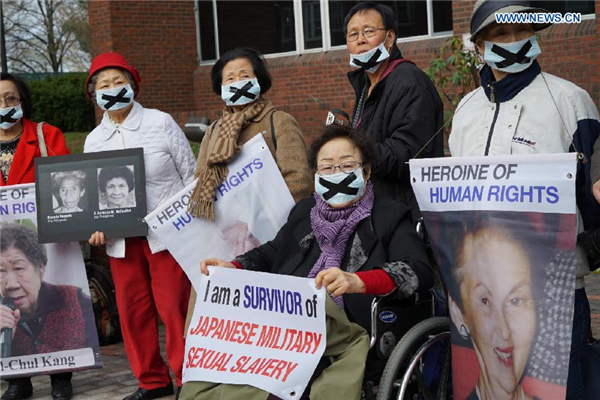
Dozens of protesters hold signs and posters urging visiting Japanese Prime Minister Shinzo Abe to look squarely at history and apologize for the crimes committed by Japan during the World War II as Abe delivers a speech at the Harvard University in Cambridge, the United States, April 27, 2015. [Photo/Xinhua] |
The other day I had a conversation with a Japanese journalist who had worked in Beijing for several years. He grew impatient when we talked about which key words Japanese Prime Minister Shinzo Abe should use for his statement to mark the 70th anniversary of the end of the World War II in August.
"Why can't we look to the future rather than look back," he said, blaming China and South Korea for using the issue of Japan's war past as a political card.
No one in Japan gives this label to Western countries, where there are also many critics of Abe and his like-minded revisionists.
Twenty historians from higher learning institutions in the United States, such as Jeremy Adelman of Princeton University, Alexis Dudden of University of Connecticut and Andrew Gordon of Harvard University, wrote an open letter that was published in the March issue of the American Historical Association's magazine, Perspectives on History. In it, they expressed their dismay at recent attempts by the Japanese government to suppress in history textbooks both in Japan and elsewhere any mention of the euphemistically named "comfort women" who suffered under a brutal system of sexual exploitation in the service of the Japanese Imperial Army during the war.
Their letter supports the many historians in Japan and elsewhere who have worked to bring to light the facts about the "comfort women" issue and other atrocities of WWII.
"We practice and produce history to learn from the past," the letter says.
In one way or another, Japan's education helps the revisionists. The schools don't teach what really happened, and the textbooks call the war an "advance" rather than what it was "aggression" by Japan.
A 2013 survey by Japan's broadcast NHK of people aged 20 or older found that only 20 percent of them accurately knew the year and date when the war started.
The public memory of the war is fading, let alone interest in learning and thinking about it.
Yet Japan's Emperor Akihito has repeatedly highlighted the importance of handing down Japan's war experiences to future generations.
"For Japan, from the beginning of the 20th year of the Showa Era when the war ended (1926-1945), there were rarely peaceful times. I believe it is very important for the people of Japan to strive to accurately understand this past history as well as the times that followed," he said back in 2005.
A year later, he said: "I sincerely hope that the facts about the war and the war dead will continue to be correctly conveyed to those of the generations that do not have direct knowledge of the war so that the kind of the ravages of war that we experienced in the past will never be repeated."
And in his New Year's message on Jan 1, he called on the Japanese people to take the 70th anniversary of the end of the WWII as an opportunity to study and learn from the history of the war, starting with the Manchurian Incident of 1931.
Abe, however, wants to sweep it all under the carpet. In his address to a joint session of the US Congress, Abe focused on the present and future and said it was time for Japan to turn the page. He refused to name his country's invasions of its neighbors as aggression.
He should explain then why roughly 1 million of the some 3.1 million Japanese who died in the WWII were killed overseas.
In an interview with Japan's daily Mainichi Shimbun, Andrew Gordon, a historian at Harvard University, said national pride requires an honest appraisal of everything done in the past. "Pride in the present and the future is built on honesty about the past, and honesty includes contrition and humility," he said.
The forward-looking Abe is eager to build up Japan's pride, but he is unwilling to take an honest look at the past.
The author is China Daily's Tokyo bureau chief. caihong@chinadaily.com.cn


I’ve lived in China for quite a considerable time including my graduate school years, travelled and worked in a few cities and still choose my destination taking into consideration the density of smog or PM2.5 particulate matter in the region.
Copyright 1995 - . All rights reserved. The content (including but not limited to text, photo, multimedia information, etc) published in this site belongs to China Daily Information Co (CDIC). Without written authorization from CDIC, such content shall not be republished or used in any form. Note: Browsers with 1024*768 or higher resolution are suggested for this site.
License for publishing multimedia online 0108263 Registration Number: 130349