 |
|
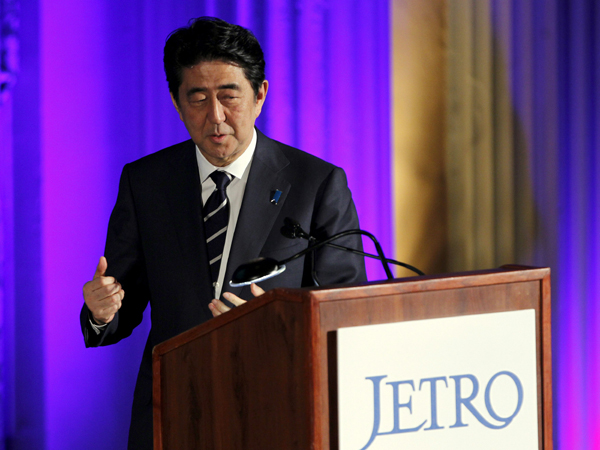
Prime Minister of Japan Shinzo Abe speaks at the Japan-US Economic Forum at the Millennium Biltmore Hotel, May 1, 2015, in Los Angeles. [Photo/Agencies] |
It is no secret that since the end of World War II, the United States has maintained its global hegemony and projected its power by forging and enhancing alliances across the world. Signals from the past week indicate there could be an important shift in the US club of allies.
Before the London-based Financial Times published an article, saying the US "no longer sees anything special in UK relations", the weeklong visit of Japanese Prime Minister Shinzo Abe to the US had grabbed much of media attention. While the United Kingdom is widely seen as the most reliable US ally in the world, Japan is no doubt the most important in the Asia-Pacific region. Yet after Abe's visit this may no longer sound 100 percent true.
While the British newspaper cited several laudable reasons, the UK's move to join the China-proposed Asian Infrastructure Investment Bank being one, for London's waning importance for Washington, the rest of the world saw the US-Japan alliance growing stronger through Abe's unprecedented visit.
Despite some measured criticisms from a few US Congressmen over his dodging of historical responsibilities, Abe was received in the US with such warmth that prompted the media to proclaim true reconciliation between the two WWII foes.
For Abe, the revision of the US-Japan defense guidelines was the biggest prize of his visit, because it not only further strengthens US-Japan alliance but also endows the alliance with global significance.
The revised defense pact eliminates the geographical limits imposed on the activities of Japanese forces and, instead, allows Japan to engage in global military cooperation in areas ranging from defense against ballistic missiles, cyber and space attacks to maritime security. Thus, one should not be surprised to see the US policing the world someday with Japan as its sidekick.
However, before the two partners really create such a scenario, they should be kindly reminded of some of the disadvantages, or even risks, the new security pact create for them.
Under the bilateral agreement, Japan will be even more tightly tied to the US global military strategy. This, in turn, will reduce the space of Japan's diplomatic maneuvering, because there is no guarantee of the island country not being drawn into armed conflicts involuntarily.
Common sense tells us an alliance of any kind, not only military alliance, could be a double-edged sword. Because of its military and political dependence on the US, Japan can never be even close to becoming a big power.
Is this what Japan really wants? Abe should have thought twice before pushing Japan into the embrace of the US.
As for the US, a stronger military alliance with Japan bodes trouble as well. Washington insists the Diaoyu Islands in the East China Sea fall within the scope of its military pact with Tokyo. The absurdity of imposing a bilateral agreement on disputes involving a third party aside, the US should ask itself whether it is ready for a head-on confrontation with China over maritime disputes between Beijing and Tokyo.
Considering that Abe has invested much of his political assets in a more nationalistic and rightist Japan, he would seize every opportunity to ratchet up tensions over the Diaoyu Islands dispute, which would turn the waters into a flashpoint in the region.
Still, this is not the end of the story. Since Japan has repeatedly refused to sincerely repent its history of aggression, a stronger role for the island country in regional and global security terrain, as promised by the newly revised US-Japan security pact, should not be seen as a blessing to regional peace and stability.
The bilateral military arrangement could only embolden Abe to seek military prominence for Japan. Therefore, it would be no exaggeration to say that the US is helping revive the ghost of Japan's military past.
As such, few countries, the UK included, would interpret Japan's newly found importance in the US club of allies as good news.
The author is a senior writer with China Daily. wanghui@chinadaily.com.cn


Copyright 1995 - . All rights reserved. The content (including but not limited to text, photo, multimedia information, etc) published in this site belongs to China Daily Information Co (CDIC). Without written authorization from CDIC, such content shall not be republished or used in any form. Note: Browsers with 1024*768 or higher resolution are suggested for this site.
License for publishing multimedia online 0108263 Registration Number: 130349