 |
|
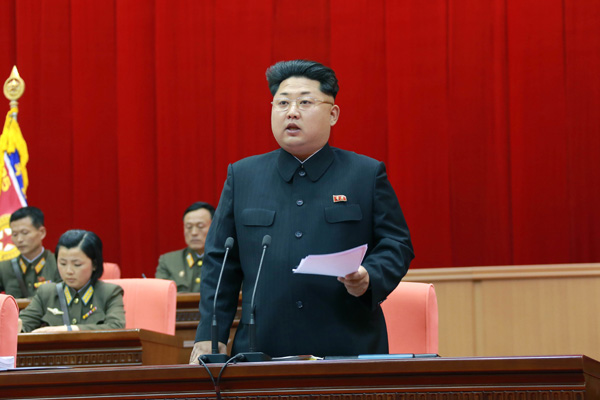
Top leader of the Democratic People's Republic of Korea (DPRK) Kim Jong-un is pictured in this photo taken on April 26, 2015. [Photo/Xinhua] |
Kim Jong-un, supreme leader of the Democratic People's Republic of Korea, has reportedly canceled his planned visit to Moscow to attend Saturday's ceremony to commemorate the 70th anniversary of Victory of the Great Patriotic War (1941-45).
Kim's absence avoids a possible embarrassing moment for China, Russia and the DPRK, as many would have speculated about ties between China and the DPRK, based on whether he would meet Chinese President Xi Jinping in Moscow or not. Given the stalled diplomatic high-level exchanges between the two countries, it is hardly good timing for their top leaders to be seen in public together.
Admittedly, China and the DPRK are also having a difficult time improving their economic integration, as the bilaterally managed two special economic zones in the DPRK's Rason, as well as Hwanggumpyong and Wihwa islands, have witnessed little progress since the agreement came into effect in 2010.
Problems such as these, however, are unlikely to sabotage the overall China-DPRK relationship. The betterment of their bilateral ties is in the interests of both countries, given the current geopolitics in the Northeast Asian region.
For Pyongyang, the mounting political, economic and security-related pressures inside and outside the Peninsula mean it is maintaining its close friendship with Beijing. In a friendly gesture to the United States, the DPRK freed three US captives in October and November. Yet it later faced a new wave of sanctions for its alleged cyberattack on US-based Sony Pictures Entertainment.
Likewise, the Republic of Korea refused to lift most of its sanctions on the DPRK, despite the latter's active participation in last year's Asian Games in Incheon. The ROK attributed the sinking of its Cheonan corvette in 2010 to a DPRK torpedo attack and imposed the aforementioned sanctions later the same year, banning almost all inter-Korean exchanges since then.
Instead, seeing Pyongyang as a grave security threat, it further strengthened its military and intelligence cooperation with Tokyo and Washington. But that is not all, both the US and the ROK have jointly pushed for a 2014 human rights resolution on Pyongyang via the United Nations, recommending the UN Security Council refer Kim to the International Criminal Court for crimes against humanity.
Although the DPRK has turned to Russia for economic aid recently, it still needs China's help for economic recovery.
As the world's second-largest economy, China on the other hand, remains the DPRK's largest trade partner, with their bilateral trade volume reaching $6.5 billion in 2014. The total value of the DPRK's foreign trade was around $7.3 billion, only $100 million of which came from the Russia-DPRK trade exchanges.
What originally led to the tensions between Beijing and Pyongyang was the latter's nuclear projects, which have proved futile and costly in safeguarding Kim's government and keeping Washington at bay as a bargain chip. China's stance on the DPRK's nuclear issue in fact serves the DPRK's interests, because only through denuclearization of the Korean Peninsula will the US and Japan alliance no longer have an excuse to build up their military forces targeted at the DPRK.
Beijing's leadership, for its part, has released a series of signals to Pyongyang to improve the bilateral relations of late. China's Foreign Minister Wang Yi said in March that China cherishes its traditional friendship with the DPRK and seeks the normal development of their relations. It, of course, takes time and efforts to get a positive response from Pyongyang, for instance, resumption of party-to-party exchanges and economic cooperation.
China needs to convince the DPRK to stick to the "Sept 19 joint statement" on denuclearization, and urge the US, Japan and the ROK to lower the threshold to return to the Six-Party Talks.
The author is a researcher with China Institutes of Contemporary International Relations in Beijing.


I’ve lived in China for quite a considerable time including my graduate school years, travelled and worked in a few cities and still choose my destination taking into consideration the density of smog or PM2.5 particulate matter in the region.
Copyright 1995 - . All rights reserved. The content (including but not limited to text, photo, multimedia information, etc) published in this site belongs to China Daily Information Co (CDIC). Without written authorization from CDIC, such content shall not be republished or used in any form. Note: Browsers with 1024*768 or higher resolution are suggested for this site.
License for publishing multimedia online 0108263 Registration Number: 130349