 |
|
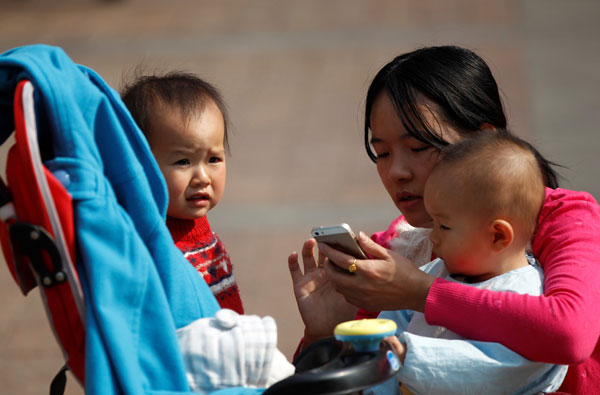
The two-child policy was put into practice in early 2014 and did not lead to the baby boom in many provinces in China. [Photo by Zou Zhongpin/for China Daily] |
Given the little change in the birth rate after the easing of the family planning policy in 2013 to allow couples one (or both) of whom is the only child of his/her parents to have a second child, the call for allowing all couples to have two children has grown.
Generally speaking, the ideal childbearing age for women is between 20 and 35 years. But nowadays people get married late. As a result, women give birth to their first child late, making it difficult for them to have a second child.
Moreover, the sharply rising cost of raising children deters many young couples from having a second child. Official data show that in 2014, only 1.07 million of the 11 million couples eligible to have a second child applied to the authorities seeking permission to do so. And the actual increase in the new births was only 470,000.
There is unlikely to be a population explosion even after all couples are allowed to have a second child, because all of them, whether or not the husband and wife are the only child of their parents, face the same monetary and social difficulties in raising children. Therefore, the call to allow all families to have a second child seems reasonable.
The right to give birth is a basic human right - this consensus was reached at the World Population Conference in Bucharest, Romania, in 1974. The conference issued a world population plan of action, which says all couples and individuals have the basic right to decide freely and responsibly the number and spacing of their children and to have the information, education and means to do so; the responsibility of couples and individuals in the exercise of this right takes into account the needs of their living and future children, and their responsibilities toward the community.
A single-child family is one of high risk, and if a majority of families in a society have only one child, that society is of high risk as well. Siblings can jointly resist the risks and uncertainties of life. The higher the proportion of single-child families in a society, the weaker will be its ability to resist such risks.
China has entered a period of super-low birth rate, which will have a huge negative impact on society. Since the reform and opening-up, the ideal number of children Chinese women have had has remained low, between 1.6 and 1.8. And because of the limitation of childbearing conditions, the actual fertility level is even lower, and this trend is worsening. Complicating the matter is the modern trend among couples to have just one child, or not have any at all.
Statistics since 2000 show that the actual birth rate in China is comparatively low, with the actual total fertility rate in recent years being less than 1.3. The fifth census in 2000 showed that the total fertility rate was only 1.22, which further dropped to 1.18 during the sixth census in 2010. In the next decade, the population of Chinese women in the best childbearing age (from 24 to 29) will drop from more than 73 million to 41 million. Even if the total fertility rate increases sharply to 1.6, the trend of falling new births will continue.
Today's newborns are the workforce of the future. If the downward trend of the total fertility rate continues for a long time, it will further complicate the problem of China's declining workforce. A sufficient working-age population is key to social and economic sustainable development. China should be worried about of the problem of shrinking population, not a population rebound in the future.
To promote a balanced population development in the long term, therefore, the authorities should allow all families to have a second child.
The author is a professor at the Population Research Institute of Peking University.


I’ve lived in China for quite a considerable time including my graduate school years, travelled and worked in a few cities and still choose my destination taking into consideration the density of smog or PM2.5 particulate matter in the region.
Copyright 1995 - . All rights reserved. The content (including but not limited to text, photo, multimedia information, etc) published in this site belongs to China Daily Information Co (CDIC). Without written authorization from CDIC, such content shall not be republished or used in any form. Note: Browsers with 1024*768 or higher resolution are suggested for this site.
License for publishing multimedia online 0108263 Registration Number: 130349