 |
|
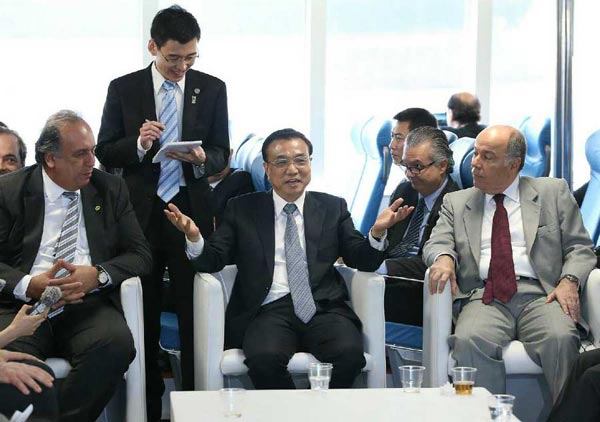
Premier Li meets with over 20 Chinese and Brazilian entrepreneurs on a China-made ferry in Rio de Janeiro on May 20. [Photo/english.gov.cn] |
Premier Li Keqiang landed in Brasilia, capital of Brazil, on Monday starting his visit to Latin America, which also takes him to Colombia, Peru and Chile. High hopes have been placed on Li's first visit to the region as premier, with many expecting him to further deepen China-Latin America cooperation, especially in equipment manufacturing, infrastructure construction, and trade and investment.
The focus is more on equipment manufacturing, for it plays a strategic role in a nation's economic development and security. Little wonder then that it tops Li's agenda.
On Tuesday, Li and Brazilian President Dilma Rousseff witnessed the signing of bilateral deals worth $27 billion, including an action plan to encourage cooperation in industrial production and feasibility research on a railway linking the Atlantic coast in Brazil to Pacific coast in Peru.
With the gross annual value of its equipment manufacturing industry exceeding that of the United States in 2009, China has become the world's largest manufacturing power. Last year, the manufacturing industry's exports value reportedly reached 2.1 trillion yuan ($338 billion), accounting for about 17 percent of China's total.
China's expertise in high-speed railways, nuclear power generation and aviation, for instance, has been widely acknowledged, especially for the relatively low expenses and quality output.
But given that Chinese equipment manufacturers are in the middle of industrial restructuring and transformation, they still have a lot to do to compete with their leading foreign counterparts. The problem is, many Chinese equipment makers depend on "primitive" technology rather than going in for technological innovation and thus can hardly catch up with foreign enterprises in terms of patented inventions and talent recruitment. Such enterprises should "go global" to acquire advanced technology as well as expand overseas.
In fact, the increasing global need for infrastructure construction, which many countries consider highly important to boost their economies and improve people's lives, offers Chinese high-speed railway enterprises, power generators and telecommunication equipment makers a golden opportunity to intensify their "go global" strategy. In this context, declining demand for infrastructure at home and Beijing's favorable "go global" policy should prompt more companies to explore overseas markets, especially in developing economies.
The Silk Road Economic Belt and 21st Century Maritime Silk Road initiatives, for instance, have reportedly "incubated" nine high-speed railway projects along the routes, and more than 20 cross-border railway and subway projects are being planned.
Also, high-level promotion by President Xi Jinping and Premier Li Keqiang during their foreign visits can help Chinese enterprises win projects and cooperate with their counterparts in other countries. The China-Brazil-Peru railway project in Latin America proposed by Xi during his visit to the region last July is a case in point.
Therefore, to encourage Chinese equipment manufacturers to become more innovative while expanding overseas, the government has to keep offering them favorable policies, by lifting administrative restrictions, for example. The government should also fully implement major programs such as "Made in China 2025", the first 10-year action plan designed to transform China from a manufacturing giant to a leader in innovation and top player.
But while expanding overseas, Chinese enterprises should take into account the economic condition, real demand and technical standards of their destination market, and forge a win-win coalition with their local counterparts. They also have to be full aware of local laws, traditions and religious sensitivities of a place before venturing in, and stay alert to political developments.
The author is an associate researcher at the Chinese Academy of International Trade and Economic Cooperation in Beijing.


I’ve lived in China for quite a considerable time including my graduate school years, travelled and worked in a few cities and still choose my destination taking into consideration the density of smog or PM2.5 particulate matter in the region.
Copyright 1995 - . All rights reserved. The content (including but not limited to text, photo, multimedia information, etc) published in this site belongs to China Daily Information Co (CDIC). Without written authorization from CDIC, such content shall not be republished or used in any form. Note: Browsers with 1024*768 or higher resolution are suggested for this site.
License for publishing multimedia online 0108263 Registration Number: 130349