 |
|
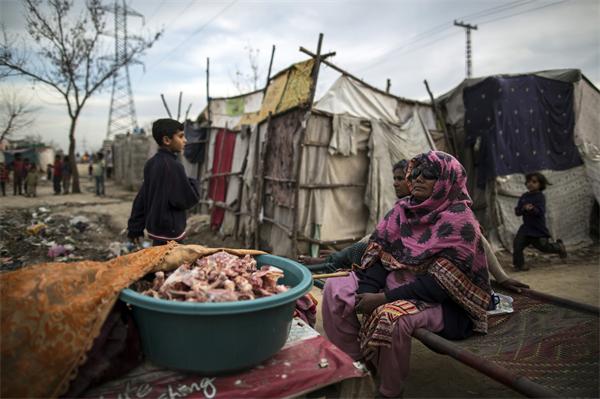
A street vendor waits for customers as she sells chicken outside her makeshift shelter at a slum on the outskirts of Islamabad March 10, 2015. [Photo/Agencies] |
The level of global debate on sustainable development is reaching new heights as the United Nations gears up for member states to negotiate the post-2015 development agenda at a landmark summit to be convened by the UN General Assembly in September.
Deliberations on the specific sustainable development goals to be adopted must, however, be reinforced by sound global economic governance and focused domestic policy frameworks, improving the inclusiveness of growth to advance the economic, environmental and social welfare of our people and the planet.
The benefits of growth have to be more widely distributed, because inclusive growth is the cornerstone of sustainable development. Mainstreaming sustainability considerations in policymaking will, in turn, support inclusiveness.
The Asia-Pacific region, with its strong growth performance and economic dynamism, has remarkably reduced extreme poverty, along with broader development. But much work remains. The latest Economic and Social Survey of Asia and the Pacific 2015 by the UN Economic and Social Commission for Asia and the Pacific forecasts for 2015 and 2016 only a single percentage point rise in levels of economic growth in the region's developing countries.
The changing dynamics in regional growth trends are driven by many factors, prominent among these being the economic rebalancing of China, which is expected to register a lower growth rate of 7 percent in 2015 - a stark contrast to investment and export-led growth averaging 9.7 percent over the last decade. The authorities, however, are managing the transition well and are counting on domestic consumption-led growth.
The good news is that there is still much scope to catalyze higher growth, with much of the region's output below its potential, and in some cases even below pre-global financial crisis levels. Better growth is contingent, however, on strong and sustained domestic reforms. Structural weaknesses, such as poor infrastructure, excessive dependence on commodities, low productivity and social deficits also keep some developing economies in the region from realizing their full growth potential.
The important lesson of recent decades is that, although economic growth is vital and necessary, it is not enough to create shared and sustainable prosperity. That requires shifting the focus of development policies to address not only "inequalities of income" but also "inequalities of opportunity". This distinction is important, because different kinds of deprivation reinforce each other. Lack of access to adequate healthcare, basic nutrition, clean drinking water, better sanitation and quality education, for example, can harm people's employment prospects, widening the gap even further between haves and have-nots, and creating a vicious spiral of inequality.
For sustainable development to succeed, growth must be made more inclusive, by addressing social and environmental deficits. ESCAP has introduced an innovative multidimensional inclusiveness index - a composite measure of 15 core indicators that track the economic, social and environmental dimensions of development in 16 countries, which together account for 92 percent of the region's population and 88 per cent of its GDP.
Inclusiveness measurements confirm that while the region as a whole has made progress over time, economic and social transformation is still lagging in some countries. Despite significant progress in making access to universal primary education easier, for example, more than half of all children of secondary school age are not even enrolled in several countries. In India's lowest-income quintile, girls on average receive only half as many years of education as boys. In Pakistan, the gap is even more glaring.
As the region prepares for the post-Millennium Development Goals era, inclusiveness must be integrated and mainstreamed in policymaking to meet these outstanding development commitments and to implement the new sustainable development agenda.
It is essential for governments to launch integrated and well-designed packages of inclusive policies to boost opportunities for decent employment and job security, equitable access to finance and to provide adequate access to basic services, such as education, healthcare, energy and water. Addressing the shortcomings of inclusive growth, together with prudent and consistent management of risks to growth, has to be a key part of our transformation for the sustainable future we want.
The author is an under-secretary-general of the United Nations, executive secretary of ESCAP and the UN's Sherpa for the G20. Previously, she served as governor of Central Bank of Pakistan and vice-president of the MENA region of the World Bank.


I’ve lived in China for quite a considerable time including my graduate school years, travelled and worked in a few cities and still choose my destination taking into consideration the density of smog or PM2.5 particulate matter in the region.
Copyright 1995 - . All rights reserved. The content (including but not limited to text, photo, multimedia information, etc) published in this site belongs to China Daily Information Co (CDIC). Without written authorization from CDIC, such content shall not be republished or used in any form. Note: Browsers with 1024*768 or higher resolution are suggested for this site.
License for publishing multimedia online 0108263 Registration Number: 130349