 |
|
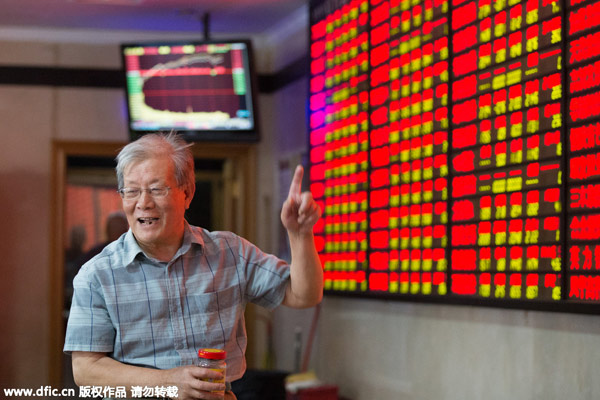
Investor at a securities brokerage in Nanjing city, East China's Jiangsu province, May 25, 2015. [Photo/IC] |
The People's Bank of China has cut interest rates three times in six months in order to lighten the debt burdens of companies and local governments. But the PBoC's monetary easing accompanied by complementary fiscal and administrative adjustments-has done little to increase demand for new loans. Instead, it has triggered a sharp rise in China's stock markets. The question now is whether that could turn out to be a very good thing.
Some 14.3 million new stock market trading accounts were opened in China last year. And the PBoC's interest rate cuts, together with reductions in banks' mandatory reserve ratios, have fueled a rise in the Shanghai, Shenzhen and ChiNext indexes of 95 percent, 198 percent and 383 percent since January 2013, although the stock market dropped 6.5 percent late last week. China's stock market capitalization grew from 44 percent of GDP at the end 2012 to 94 percent of GDP in early May.
This has important potential implications-both positive and negative. On the positive side, the revival of China's stock market in a low-interest-rate environment represents an important shift in asset allocation away from real estate and deposits. About 50 percent of Chinese savings amounting to as much as half of GDP-lie in real estate, with 20 percent in deposits, 11 percent in stocks and 12 percent in bonds. To compare, in the United States, real estate, insurance and pensions each account for about 20 percent of total savings, with 7.4 percent in deposits, 21 percent in stocks and 33 percent in bonds.
Rising stock-market capitalization also helps to curb the real economy's exposure to bank financing. The US is much more "financialized" than China, with stocks and bonds amounting to 133 percent and 205 percent of GDP at the end of 2013. Those ratios were only 35 percent and 43 percent, respectively, in China. And China's bank assets amounted to 215 percent of GDP-more than double of the US' 95 percent.
Finally, China's surging stock prices increased net wealth by 37 trillion yuan ($6 trillion), equivalent to 57 percent of China's GDP, in just 18 months. If stock prices can be sustained, the implications for consumption, liquidity and leverage will be profound. Smart households and entrepreneurs could take profits and reduce their debts. Similarly, both private enterprises and State-owned enterprises could use market buoyancy to raise equity to fund new investments.
But the rapid run-up in equity prices also carries considerable risks-namely, the possibility that the financial sector will misuse the newfound liquidity to finance more speculative investment in asset bubbles, while supporting old industries with excess capacity. That is what happened in 2008-09, when a run-up of the Shanghai index (which reached 6,092 in October 2007), together with the government's 4-trillion-yuan stimulus package, sustained overcapacity in traditional industries. Most of the credit went to real estate and local infrastructure projects, effectively reinforcing the most problematic trends in China's economy.
This time, one hopes, will be different. But even if China's retail investors begin to channel their money toward innovative ventures, identifying the companies and industries most likely to succeed will be difficult.
In the US, the collapse of the tech bubble in 2000 entailed a $4-trillion loss in market capitalization. But the US managed to avoid a systemic crisis. If China's animal spirits are allowed to operate through market mechanisms, distinguishing real value from aspirational prices, China, too, can stay the course toward the new economy, despite the failures and consolidation that will inevitably occur.
That is why the real test of China's administrative reforms is whether, through improved bankruptcy mechanisms and regulations that block fraud and market manipulation, they allow-and even facilitate-the effective functioning of market forces. With animal spirits-not the authorities-guiding it, China can build the high-value-added, high-tech economy it needs to compete in the future.
Andrew Sheng is distinguished fellow of the Fung Global Institute and a member of the UNEP Advisory Council on Sustainable Finance. Xiao Geng is director of research at the Fung Global Institute. Project Syndicate


I’ve lived in China for quite a considerable time including my graduate school years, travelled and worked in a few cities and still choose my destination taking into consideration the density of smog or PM2.5 particulate matter in the region.
Copyright 1995 - . All rights reserved. The content (including but not limited to text, photo, multimedia information, etc) published in this site belongs to China Daily Information Co (CDIC). Without written authorization from CDIC, such content shall not be republished or used in any form. Note: Browsers with 1024*768 or higher resolution are suggested for this site.
License for publishing multimedia online 0108263 Registration Number: 130349