 |
|
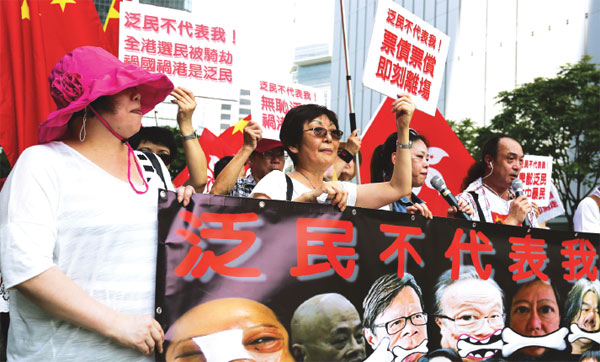
Residents wave banners condemning the opposition during a rally in support of the electoral reform package outside the Central Government Offices on June 11, 2015. Parker Zheng / China Daily |
The Hong Kong Special Administrative Region government will submit its constitutional reform plan to the Legislative Council on Wednesday. The first Hong Kong chief executive (CE) was chosen by a selection committee and appointed by the central government. Since the second term, the CE has been chosen by the Election Committee and all of them appointed by the central government.
The selection committee and Election Committee represent the progress the SAR has made since Hong Kong's reunification with the motherland in 1997, but they still don't meet all the requirements of universal suffrage.
According to Article 45 of Hong Kong's Basic Law, the goal of the constitutional reform is the selection of the CE through universal suffrage after being nominated by a broadly representative Nomination Committee in accordance with democratic procedures. The most important goal of universal suffrage is to grant every voter in Hong Kong the right to vote.
But some people say universal suffrage must be electing the CE and Legislative Council members through direct vote. And this is the cause of all the confusion and misunderstandings over universal suffrage.
The core of universal suffrage principle is that all voters, irrespective of their gender, economic status, education level and ethnicity, should be able to vote. In this sense, people voting to elect a CE from among the candidates chosen by the Nomination Committee is true universal suffrage, and universal suffrage in Hong Kong is also direct election, that is, people casting their votes themselves rather than through representatives or agencies.
Some people in Hong Kong want to add public nomination and party nomination to the nomination process, which don't have any legal basis. First, nomination subjects that are outside the Basic Law's stipulation don't have nomination rights. Election is a matter of public law. And the Basic Law says the Nomination Committee has the power to nominate CE candidates, which means no other individual or organization has the right to do so.
And second, public nomination is a misunderstanding of direct election, for it includes public nomination in the direct election process, confusing it with the right of the public to vote.
Hong Kong's constitutional reform plan is aimed at implementing true universal suffrage at all the stages of election, from recommendations to casting of ballots. To start with, any individual can apply to be a Hong Kong CE candidate as long as certain conditions for the post are fulfilled.
At the recommendation and nomination stage, all the applicants have equal opportunity, because any of them can drum up support from the 1,200 members of the Nomination Committee.
At the voting stage, formal candidates for the post of CE (those that meet all the Nomination Committee's requirements) have equal rights to be elected, as long as they meet the requirements of Article 44 of the Basic Law of being "a Chinese citizen of not less than 40 years of age who is a permanent resident of the (Special Administrative) Region with no right of abode in any foreign country and has ordinarily resided in Hong Kong for a continuous period of no less than 20 years".
Also at the voting stage, all the about 5 million eligible Hong Kong voters enjoy the "one person, one vote" universal suffrage right. All the voters enjoy universal and equal rights to vote to elect the Hong Kong CE, which is the highlight of universal suffrage in the SAR.
In other words, if two-thirds of the members of the Legislative Council approve the universal suffrage plan, Hong Kong voters' dream of universal suffrage will come true. Universal suffrage in Hong Kong CE's election means equal, fair, democratic and competitive election, which is true universal suffrage and a milestone in the SAR's democratic process.
Hopefully, Legislative Council members realize their historical responsibility and contribute to Hong Kong's constitutional reform.
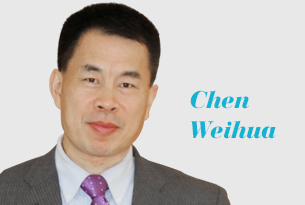
The author is a professor of law at Peking University.


I’ve lived in China for quite a considerable time including my graduate school years, travelled and worked in a few cities and still choose my destination taking into consideration the density of smog or PM2.5 particulate matter in the region.
Copyright 1995 - . All rights reserved. The content (including but not limited to text, photo, multimedia information, etc) published in this site belongs to China Daily Information Co (CDIC). Without written authorization from CDIC, such content shall not be republished or used in any form. Note: Browsers with 1024*768 or higher resolution are suggested for this site.
License for publishing multimedia online 0108263 Registration Number: 130349