 |
|
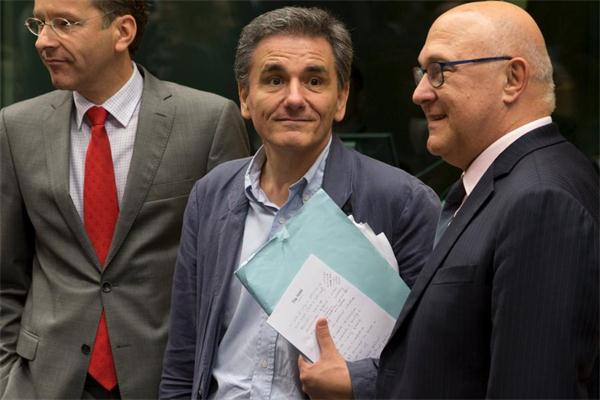
Newly appointed Greek Finance Minister Euclid Tsakalotos (C) is welcomed by Eurogroup President Jeroen Dijsselbloem (L) and French Finance Minister Michel Sapin at a euro zone finance ministers meeting on the situation in Greece in Brussels, Belgium, July 7, 2015. [Photo/Agencies] |
On Sunday 61 percent of Greeks voted against the strict austerity terms demanded by the European Union and International Monetary Fund. For Greece's international creditors it was a case of Apocalypse at the Acropolis.
Greek Prime Minister Alexis Tsipras said the result gave him a mandate to strike a better deal within the eurozone, which is code for debt relief alongside structural reform (rather than relief only after reform). To help repair relations with the EU he sacked his outspoken finance minister, Yanis Varoufakis, who had described the creditors as "terrorists".
Eurozone finance ministers say they expect to hear new proposals from Greece after the country voted to reject the terms of the bailout. Germany's economy minister has warned that any unconditional debt write-off would destroy the single currency.
In the short term the immediate problem is how to maintain some liquidity in the Greek banking system. Greek banks remain closed and there is an additional ban on taking money from bank safety deposit boxes.
The leaders of the European Central Bank and EU are facing a number of big decisions. The ECB must decide whether to pull its lifeline to Greek banks or defer to political leaders in the hope of a muddle-through or new deal. German Chancellor Angela Merkel must decide whether she is willing to go along with some debt relief or continue to hold out against Tsipras. Many smaller EU countries will be furious if she does soften her tough stance after the experiences they suffered in recent years.
Essentially the EU has to decide whether another bailout, accompanied by some debt relief, is politically possible, or do they send Greece packing from the eurozone. The choice is all the harder because the resounding No dents the EU's credibility as a union of the people.
There are worries that failure to resolve the Greek crisis will have a knock-on effect elsewhere in Europe and in the world at large. These worries are over-stated as the ECB has built up firewalls to prevent other countries being hit. The previous problem countries including Spain, Portugal and Ireland have all made substantial efforts to reform their economies in the past few years.
Furthermore the Greek economy is less than two percent of the EU economy and many consider that a Grexit would actually lead to a stronger euro. Global stock markets took a tumble after the no vote but most recovered within 24 hours.
The crisis has lasted over five years and could last another five or even longer. Since the first big bailout in 2010 successive Greek governments have failed to implement the necessary reforms demanded by IMF and EU creditors. This led to no growth and mounting debt with Greek politicians from all sides ready to blame everyone but themselves.
Their failure to deliver a functioning tax system meant a showdown with creditors would become inevitable. In a mutual display of self-righteousness, creditors decided to stop throwing good money after bad. Greece, under the left-wing Syriza government, insisted on debt relief before deep reform. The policy gaps grew wider and the professional differences turned personal. To hold his party together Tsipras called the referendum in an effort to force the EU to modify its position. So far the gamble has not worked.
Strangely, the Yes campaign was nearly invisible both before and after the vote. After failing to rally around a face or a simple brand like the euro, their failure at the ballot box did not surprise locals. Overall Greeks seem proud to give European leaders a bloody nose, but they still don't know what lies ahead. One thing is certain - the road ahead will be long and difficult.
The author is director of the EU-Asia Centre in Brussels.


I’ve lived in China for quite a considerable time including my graduate school years, travelled and worked in a few cities and still choose my destination taking into consideration the density of smog or PM2.5 particulate matter in the region.
Copyright 1995 - . All rights reserved. The content (including but not limited to text, photo, multimedia information, etc) published in this site belongs to China Daily Information Co (CDIC). Without written authorization from CDIC, such content shall not be republished or used in any form. Note: Browsers with 1024*768 or higher resolution are suggested for this site.
License for publishing multimedia online 0108263 Registration Number: 130349