 |
|
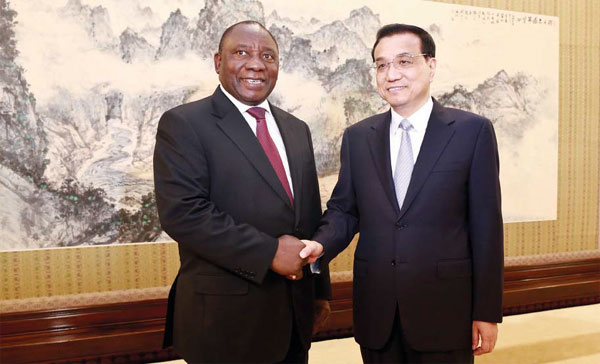
Chinese Premier Li Keqiang meets with South African Vice-President Cyril Ramaphosa in Beijing on July 14. Wu Zhiyi / China Daily |
In his attention-grabbing visit to Africa last week, US President Barack Obama made misleading remarks about China's cooperation with Africa, which has created the impression that the United States sees China as a rival, rather than a cooperative partner, in the African continent.
"The US isn't the only country that sees your growth as an opportunity and that is a good thing," Obama said in a speech in Ethiopia's capital, Addis Ababa.
"But economic relationships can't simply be about building countries' infrastructure with foreign labor or extracting Africa's natural resources. Real economic partnerships have to be a good deal for Africa. They have to create jobs and capacity for Africans," Obama said.
Obama's rhetoric has been widely seen as a veiled criticism of China over its ties with the African continent. But it lays bare the US' mentality, as the world's sole superpower has lagged far behind China in promoting comprehensive cooperation with the continent in recent years.
Infrastructure plays an arguably important role in international cooperation with Africa, which is thirsty for better roads and railways, more power generation capability and other infrastructure. The convention center in Addis Ababa where Obama delivered his speech was China-built.
The numerous infrastructure projects China has been building in the Africa continent, including advanced telecommunication networks, are providing a solid foundation as well as vast opportunities for African countries' further development.
In recent years, especially since the founding of the Forum on China-Africa Cooperation in 2000, China and Africa have been making big strides in deepening their reciprocal cooperation in a wide range of fields.
Compared with the old model in which China largely focused on providing free aid to those in need in Africa, Sino-African interaction has become more mature in recent years and focused on capacity building.
Two-way trade between China and African countries surpassed $200 billion for the first time in 2013, and by the end of 2012, China's direct investment in the continent added up to nearly $20 billion, with 75 percent going to such sectors as finance, processing and manufacturing, trade-related services, agriculture and transportation.
To date, more than 2,000 Chinese enterprises have invested in 50 African countries, with the large majority of their employees Africans.
In contrast, US-African economic interaction has been a different story. Statistics from the US show trade between America and Africa rose from $33 billion in 2002 to $142 billion in 2008, but declined to $73 billion last year and it continues to fall this year.
Yet, due to their deep-rooted bias towards China-African ties, some in the West claim China's policy in Africa is "neocolonialism" and "resource diplomacy". What Obama said in Africa last week indicates the US president is singing the same old tune.
It is known to all that the West's colonization in Africa, which lasted for hundreds of years dating back to the 15th century, is largely responsible for the backwardness and poverty that continue to plague many African countries today. Western powers, in particular those in Western Europe separated from Africa only by the Mediterranean, still harbor the old mentality that Africa is their "backyard".
As such, the West apparently needs a more objective lens to see the reality and profound implications of China-Africa interaction. The investment and policies of China and the US in Africa are not a zero-sum game as the two countries have shared interests in Africa.
The world's two biggest economies do not necessarily need to treat each other as rivals in Africa as the continent is big enough for both of them to play their part as long as their efforts lead to all-win outcomes.
There are already examples of China-West cooperation in humanitarian aid in Africa and in the fight against Ebola epidemic in West Africa last year China and the US should join hands to help the continent fight poverty, improve its infrastructure and address its security challenges.
The author is a senior writer with China Daily. wanghui@chinadaily.com.cn


Copyright 1995 - . All rights reserved. The content (including but not limited to text, photo, multimedia information, etc) published in this site belongs to China Daily Information Co (CDIC). Without written authorization from CDIC, such content shall not be republished or used in any form. Note: Browsers with 1024*768 or higher resolution are suggested for this site.
License for publishing multimedia online 0108263 Registration Number: 130349