 |
|
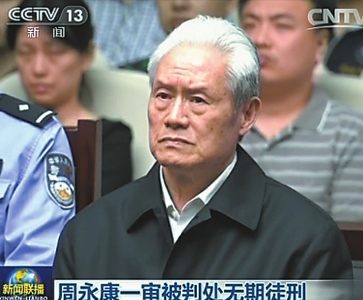
A screen grab from CCTV shows Zhou Yongkang waiting to hear his sentence at a Tianjin court on Thursday. CHINA DAILY |
The intensification of China's anti-corruption campaign and the investigations against an increasing number of "tigers", or high-ranking corrupt officials, have given rise to a debate on whether people who have risen from a humble family background are suited to occupy high positions.
Skeptics have furnished "evidence" to back their argument. They say a number of corrupt high-ranking officials - from Zhou Yongkang, a former member of the Standing Committee of the Political Bureau of the Communist Party of China Central Committee, and Xu Caihou, former vice-chairman of the CPC Central Military Commission, to Liu Zhijun, former minister of railways, Guo Boxiong, another former vice-chairman of the CMC, and some other corrupt officials - were born in poor families.
Similar to doubting the ability of "phoenix men", men who were born in poor families but achieved great success in their careers through hard work, some people believe officials from a humble family background, especially those occupying high positions who control a lot of resources, are usually more vulnerable to material temptations.
But this is wrong, because there is no scientific basis for labeling a specific group of people as irresponsible, and such a perception has the potential of giving rise to prejudice and creating a barrier against people from poor families, which could undermine social harmony.
Some of the high-ranking officials convicted of or detained for corruption may have been born in poor families, but does that mean every senior official who has risen from a humble family background is prone to corruption? Certainly not.
Besides, available data do not show how many officials come from poor families or, for that matter, from second-generation officials' or wealthy households. Thus, we cannot be sure about which corrupt official belongs to which specific class. So, the assumption that "children born in poor families are not suited to occupy high-ranking posts" is simply preposterous.
It is equally important to note that "people born in poor families" are not the only targets of such prejudice, which also questions the integrity of so-called second-generation officials and the wealthy. Such attempts to link the identify of a specific group with corruption, if not stopped now, could vitiate the social atmosphere. To determine what types of officials are more prone to corruption, we have to take the political environment as a key factor.
For every new official, the political environment plays a very important role in shaping his/her growth. A good political environment will help an official to develop a healthy outlook on life and lay a good foundation for his/her future. That's why top leader Xi Jinxing has emphasized, "to strengthen the building of the Party, we must try to create a good environment and a good political ecology for officials".
An official, irrespective of family background, will turn out to be a conscientious servant of the people even at a high position if working under an honest and responsible superior and in a clean political environment.
Also, good institutional guarantees are necessary for the cultivation of virtuous officials. An analysis of the cases of the "tigers" will show that most of them embarked on the path of corruption when they held lower positions, and the lack of effective institutional monitoring encouraged them to commit bigger mistakes.
In other words, there is no reason to attribute officials' corrupt practices to their family backgrounds.
The article was originally published in China Youth Daily on Wednesday.
(China Daily 08/08/2015 page5)


I’ve lived in China for quite a considerable time including my graduate school years, travelled and worked in a few cities and still choose my destination taking into consideration the density of smog or PM2.5 particulate matter in the region.
Copyright 1995 - . All rights reserved. The content (including but not limited to text, photo, multimedia information, etc) published in this site belongs to China Daily Information Co (CDIC). Without written authorization from CDIC, such content shall not be republished or used in any form. Note: Browsers with 1024*768 or higher resolution are suggested for this site.
License for publishing multimedia online 0108263 Registration Number: 130349