 |
|
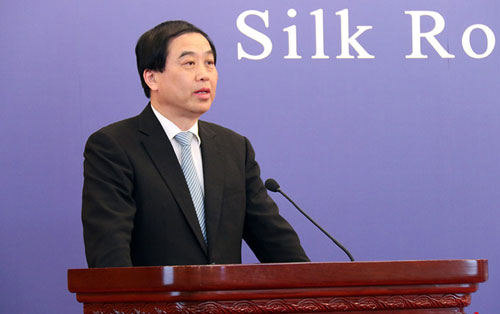
Zhu Minyang, mayor of Yangzhou, gives a speech at the press conference of the food festival in Beijing. [Photo provided to chinadaily.com.cn] |
The China-proposed Silk Road Economic Belt is akin to the ancient Silk Road in many aspects. The ancient Silk Road was not only a trade route, but also a road for communications among civilizations and three continents - Asia, Europe and Africa. It was born to meet the strong commercial needs of the East and the West, from China to Central Asia, West Asia and Europe.
Archaeological evidence suggests Greece was introduced to silk commodities from China as early as 6th century BC. And as the two biggest empires in West-Southwest Asia and Europe, the Achaemenid (or Persian) Empire that rose in 6th century BC and the Macedonian Empire that was formed around 334 BC greatly promoted commerce and cultural exchanges with China.
Correspondingly, Chinese rulers desperately sought to ally with some empires and regimes to China's west, in a bid to prevent the nomadic people in the north from invading China. Emperor Wu Di of the Han Dynasty (206 BC - 220 AD) sent his envoy Zhang Qian to persuade some regimes to the west to ally with China in 138 BC. Zhang didn't succeed in the mission, but he opened a trade route with Central Asia. Gradually, the Silk Road became the world's most important trade route despite traders being frequently targeted by bandits and trade suspended many times because of wars.
The Han rulers sent their second envoy Ban Chao in 73 AD to try to reopen the road. In 97 AD, Ban Chao sent envoy Gan Ying to Da-qin (Rome). Gan Ying reached the Persian Gulf, close to the eastern boundary of the Roman Empire, the first Chinese to do so in recorded history. After that, the businessmen from the Rome came to the Eastern Han Dynasty's capital of Luoyang, which signaled the reopening of the Silk Road.
The maritime Silk Road started during the Qin Dynasty (221 BC-206 BC) and reached its peak during the Ming Dynasty (1368-1644). It linked Chinese ports with Korea and Japan, Southeast Asia, South Asia, the Arabian Peninsula and East Africa.
The Silk Road developed over 2,000 years across grasslands, deserts, seas and forests on the Eurasian continent, and the main commodities traded were tea, fur, feather, silk, jade, china, jewelry and spices. China, on its part, got many vegetables, fruits and other important agricultural plants through the Silk Road trade.
The Silk Road spread technology, too. The four great inventions of ancient China, papermaking, printing, compass and gunpowder reached the West through the Silk Road, greatly boosting the development of Western societies. And thanks to the Silk Road, Buddhism, Christianity, Islam, Manicheism and Taoism spread rapidly to wider areas.
The modern-day overland and maritime Silk Roads China has proposed will embody the spirit and functions of the the ancient Silk Road. A rising China shoulders the responsibility of promoting common development and prosperity across the world. And the "Belt and Road Initiative" will provide China with the means to fulfill this responsibility.
Since the end of the Cold War, many countries have proposed to make good use of the strategic space in Eurasia for various purposes. But China's initiative is for the well-being of all the people in the region, because it sees the region as a community of shared interests and destiny.
It is important that all issues and disputes in building of the modern Silk Roads are settled through peaceful negotiations. China has proposed the initiative, but it is not the only advocate or undertaker of the projects. The Silk Roads will be built with the joint efforts and cooperation of all relevant countries.
The author is a researcher in Chinese borderland at the Chinese Academy of Social Sciences. The above is an abridged version of his speech at the Xinjiang Development Forum in Urumqi on Tuesday.


I’ve lived in China for quite a considerable time including my graduate school years, travelled and worked in a few cities and still choose my destination taking into consideration the density of smog or PM2.5 particulate matter in the region.
Copyright 1995 - . All rights reserved. The content (including but not limited to text, photo, multimedia information, etc) published in this site belongs to China Daily Information Co (CDIC). Without written authorization from CDIC, such content shall not be republished or used in any form. Note: Browsers with 1024*768 or higher resolution are suggested for this site.
License for publishing multimedia online 0108263 Registration Number: 130349