 |
|
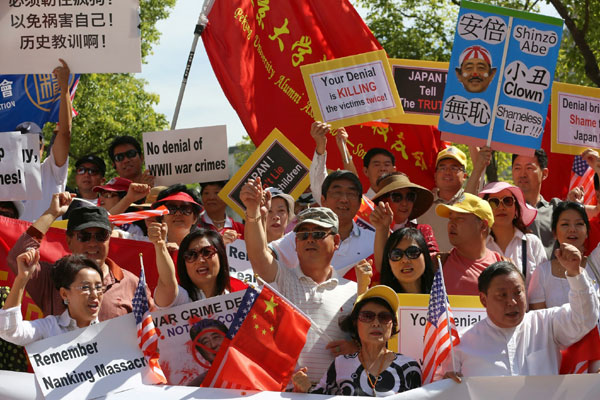
Hundreds of protesters rally on May 1 near the Millennium Biltmore Hotel in Los Angeles where Japanese Prime Minister Shinzo Abe was scheduled to attend a luncheon. They demanded that Abe apologize for Japan's wartime wrongdoings. Provided to China Daily. |
In 1993, Japanese politician Ichiro Ozawa first said that transforming Japan into a "normal country" was the way to make it a "real member" of the international community again. The central point of Ozawa's argument for transforming Japan into a "normal country" was to make sure it was treated as equal by other countries, its national power was acknowledged, and the international community saw its pursuit of security and development as normal.
Since then, Japan's domestic and foreign policies have been, more or less, focused on the "normal country" disposition. But is Japan closer to its objective under Prime Minister Shinzo Abe's leadership?
Japan's pacifist Constitution stipulates the country cannot have a war-oriented military or declare war on another country. And the Charter of United Nations says relevant countries and organizations can take necessary actions, without the UN Security Council's authorization, to prevent or stop a war by any of the countries that started World War II. Together, the two statutes make Japan different from other countries.
Ever since its inception in the 1950s, the Liberal Democratic Party has been trying to amend Japan's pacifist Constitution to build a legal foundation for the country to more aggressively take part in international affairs. But the strong pro-peace forces in Japan have been thwarting its efforts.
The international community does not oppose Japan's pursuit for security and development. Almost every postwar Japanese prime minister has made some sort of breakthrough in autonomous diplomacy and defense. Abe has changed the Constitution's legal interpretation. But since such a change is not enough to allow Japan to exercise the right to "collective self-defense", Abe now wants to amend the Constitution itself to enable Japan to earn that right.
Exercising the right to "collective self-defense" and changing the Guidelines for Japan-US Defense Cooperation are part of Tokyo's plan to acquire a status close but equal to the US. That Abe played up the concept of active pacifism after becoming prime minister for the second time indicates he is desperate to make Japan not only a "normal country" but also a big world power.
The Abe administration has emphasized the harsh security challenges China poses to Japan to win public support for the passage of the new security bills. The new bills will enable Japan to intervene in international conflicts and become a "dynamic defense power" - a strong military power with global presence. But the Japanese people don't want to go that far.
The lower house passed the security bills last month despite the people's opposition. The new bills will markedly expand Japan's Self-Defense Forces' freedom and scale of operation in the UN's peacekeeping missions. And Abe believes he can use the UN missions as a legal tool to bypass the restrictions of the pacifist Constitution. No wonder some countries equate Japan's efforts to become a "normal country" with remilitarization.
By visiting the Yasukuni Shrine, which among other honors 14 Class-A war criminals, and doubting the legality of the Tokyo Trials, Abe is apparently promoting nationalism among the Japanese people, but in reality he is trying to spread a wrong view of history.
It is widely believed that Japan has the potential to make nuclear weapons within a short time. The "normal country" that Abe wants to make Japan to become will actually not be normal, because he attaches great importance to the use of military power to defend national interests and has political ambitions that only leaders of big powers have.
The international community must pay close attention to the developments in Japan, which refuses to sincerely repent, let alone apologize, for its war crimes even 70 years after the end of WWII.
The author is a researcher in international politics at the Shanghai Academy of Social Sciences.


I’ve lived in China for quite a considerable time including my graduate school years, travelled and worked in a few cities and still choose my destination taking into consideration the density of smog or PM2.5 particulate matter in the region.
Copyright 1995 - . All rights reserved. The content (including but not limited to text, photo, multimedia information, etc) published in this site belongs to China Daily Information Co (CDIC). Without written authorization from CDIC, such content shall not be republished or used in any form. Note: Browsers with 1024*768 or higher resolution are suggested for this site.
License for publishing multimedia online 0108263 Registration Number: 130349