 |
|
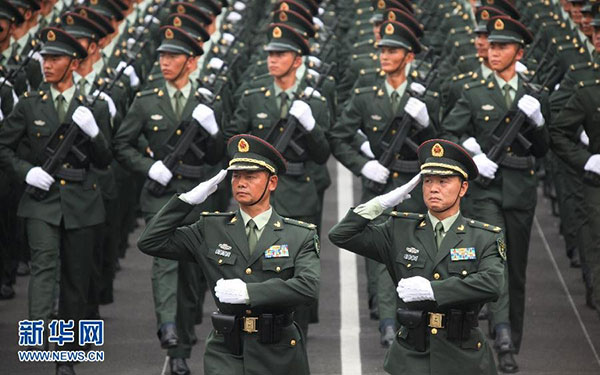
Major General Cheng Xiangwen (Left) and Major General Zhu Yunxuan (right) salute during a session with soldiers from their marching unit on July 22, 2015. They are preparing for the Sept 3 military parade to mark the 70th anniversary of victory in the War of Resistance Against Japanese Aggression. [Photo/Agencies] |
China's decision to hold a military parade on Sept 3 to mark the 70th anniversary of the end of World War II serves important domestic and global purposes.
Domestically, the idea is to rally the Chinese people around a new shared national history, one constructed around the joint resistance against foreign invasion and the struggle to create a new modern, prosperous and cohesive nation. And the display of military hardware is meant to suggest that China has the military wherewithal befitting a great power and can keep its people safe, important because China for almost two centuries suffered defeat after defeat and invasion after invasion.
Globally, the commemoration is meant to draw attention to China's role in WWII, illustrating that it played as important a role as the US, the Soviet Union and Great Britain, and that China, too, stood on the side of the good. Although in the West China's role in WWII still receives little attention, in China it is now seen as one of the most crucial periods in its history.
Japan surrendered its forces in China not on Sept 3, 1945, but on Sept 9, 1945, in Nanjing at 9 am. The timing - the ninth hour of the ninth day of the ninth month - echoed that of the end of WWI, when the armistice that had been agreed began on the 11th hour of the 11th day of the 11th month, a moment still commemorated around the world with a minute's silence and meant to suggest the peace won in 1945 would last forever.
China's choice of 9-9-9 in 1945 was apt especially because the Chinese words for "nine" and "enduring" sound similar. Chiang Kai-shek, then China's leader, declared that China's policy would be "to repay aggression with generosity". It is important to recall that initial response for its yearning for reconciliation and insistence on benevolence.
The three days of national commemoration, which the present Chinese leadership decided on last year, reflect that spirit. From now on, victims of the Nanjing Massacre will be commemorated on Dec 13 and China's victory over Japan will be observed on Sept 3. The inclusive nature of these commemorations is remarkable, for they accord dignity to the erstwhile domestic rivals of the Communists, Chiang Kai-shek's Kuomintang. This year's commemoration illustrates that determination too, because it includes Communist and Kuomintang veterans both.
It is also useful to recall former German president Richard von Weizsacker's speech on May 8, 1985. He said that for Germany, too, its surrender to the Allies on May 8, 1945, was a day of liberation, not of defeat, for it made a new, humane future possible. While von Weizsacker said "the vast majority of today's population was either young or had not been born" and hence "cannot be expected to wear a penitential robe" for being German, they could not escape "the grave legacy" their forefathers had left them. Everybody will have to acknowledge the horrors that had been perpetrated, wholeheartedly, honestly and without any conditions. Von Weizsacker's speech was welcomed around Europe because of its unflinching honesty and moral acuity. It restored a measure of trustworthiness to postwar Germany.
East Asia and Europe are different, and WWII played out differently in the two regions, hence one should not be taken as a standard by which to judge the other. It is clear that in East Asia the WWII legacy of hatred is stronger and more divisive than it is in Europe. Reconciliation, though, is hard work, which requires humility and courage in equal measure.
In 1984, Helmut Kohl and Francois Mitterand, then German and French leaders, were finally able to stand together at a war cemetery at Verdun, France, housing the remains of tens of thousands of French and German soldiers. Memorably, they held hands during the minutes of silence and no speeches were delivered.
If von Weizsacker was right in insisting that Germany's surrender was a form of liberation, perhaps it is also true that what we must remember of WWII is that it was a horror for all - a defeat for humanity as a whole - something that must never happen again, and for that we all share a heavy responsibility.
The author is professor of Modern Chinese History, Department of East Asian Studies, Cambridge University.


I’ve lived in China for quite a considerable time including my graduate school years, travelled and worked in a few cities and still choose my destination taking into consideration the density of smog or PM2.5 particulate matter in the region.
Copyright 1995 - . All rights reserved. The content (including but not limited to text, photo, multimedia information, etc) published in this site belongs to China Daily Information Co (CDIC). Without written authorization from CDIC, such content shall not be republished or used in any form. Note: Browsers with 1024*768 or higher resolution are suggested for this site.
License for publishing multimedia online 0108263 Registration Number: 130349