 |
|
Wang Xiaoying/China Daily |
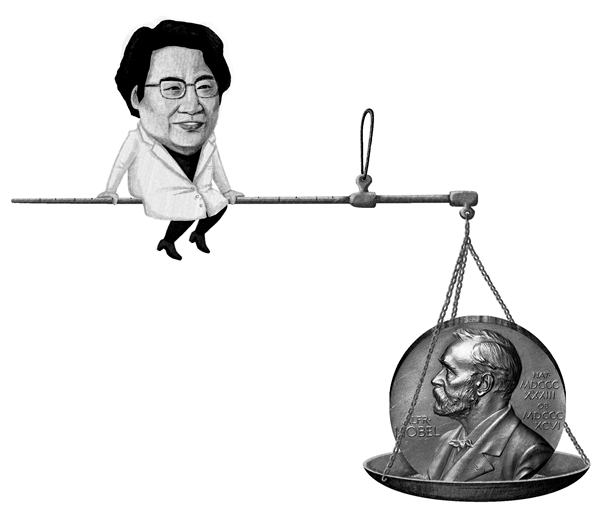
The announcement of this year's Nobel Prize in medicine has triggered a new debate on traditional Chinese medicine, and reminds us that modern medical science depends on inspiration from every possible source.
A Chinese scientist winning the Nobel Prize for an anti-malarial drug based on an ancient remedy has rekindled the debate about traditional Chinese medicine.
Amid reports on crowded tourist destinations and shopaholic crazes typical of the "golden week" holiday, the news that a Chinese pharmacologist just won this year's Nobel Prize for Physiology or Medicine sent notes of congratulations flying through cyberspace like a blizzard in deep winter. Tu Youyou is the first Chinese national to win a medicine Nobel, and the first Chinese woman to win any Nobel. Pride was running high.
But beneath the flutter of excitement was a serious debate, which has been going on and off for quite a while and is naturally reheated once the Nobel news broke out. It concerns the validity of traditional Chinese medicine, or TCM for short. You see, Tu was recognized for Artemisinin, a therapy against malaria that is extracted from a herb popularly known as sweet wormwood. It was first mentioned in an ancient Chinese prescription more than 2,000 years ago.
In the renewed clashing of opinions, some view Tu's Nobel as the ultimate endorsement of TCM while others contend that it proves the opposite-that Western medicine is more effective-because even in China's regulation of the pharmaceutical industry Artemisinin is classified as a "chemical drug", which is colloquially equivalent to "Western medicine".
Now I'm no expert on TCM or science of medicine in general. But reading through the posts has enriched me with knowledge to offer a layman's take on the matter. I truly admire those like Fang Zhouzi who possess a vast warehouse of information and knowledge and can help explain the arcana of science to us outsiders, but on the other hand I feel that many tend to go to extremes when they draw conclusions on the virtue, or the lack thereof, of TCM.
As I see it, the name "Western medicine" (xiyao) as a catch-all phrase is a misnomer that serves only to polarize. The methodologies for making these drugs may have been first invented in Western countries, but they are now adopted worldwide. What if we add "Western" to other sciences such as physics, biology, architecture etc? Say, if we call a building with reinforced concrete instead of wooden nails "a Western house", people will raise their eyebrows as if you are from another planet. The adjectives "Western" and "Chinese" are used only to describe a building's style or decoration.
I see the term "Western medicine" as a vestige from the early days when China only started to import scientific knowledge and products from more advanced countries. But we no longer call an electric bulb "a foreign lamp" (yangdeng). But when you say "I prefer Western medicine", there is the instant connotation that you stand up for science (in the eyes of TCM detractors) or you have spurned your native culture (in the eyes of TCM defenders).
Now, nobody will accuse you of cultural betrayal if you say you like an electric lamp over an oil-fueled one.
 Being unaware of hypocrisy is itself hypocrisy

Copyright 1995 - . All rights reserved. The content (including but not limited to text, photo, multimedia information, etc) published in this site belongs to China Daily Information Co (CDIC). Without written authorization from CDIC, such content shall not be republished or used in any form. Note: Browsers with 1024*768 or higher resolution are suggested for this site.
License for publishing multimedia online 0108263 Registration Number: 130349