 |
|
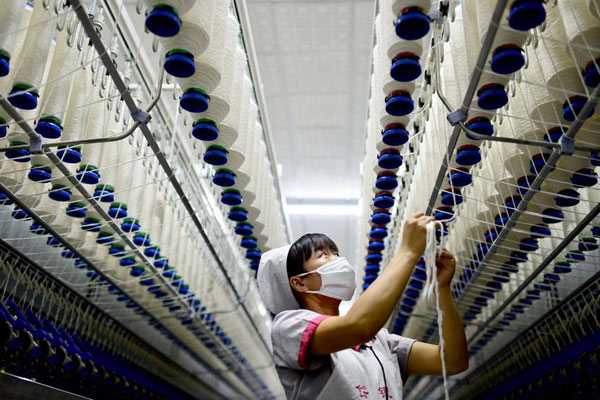
A worker at a textile company in Shandong, Oct 21, 2014. [Photo/Xinhua] |
Barely had Chinese policymakers managed to convince global investors of the long-term value of the renminbi to check unjustified devaluation, than the United States called on China to allow its currency to appreciate further to support its economic rebalancing.
The US Treasury's latest semi-annual report on economic and currency policies of major trade partners not only recognized the fact that the Chinese currency had appreciated against the greenback nearly 30 percent over the past five years. It also noted that, against market expectations of a much deeper fall, data suggests Beijing "sold a significant amount of reserves in August to stem the RMB decline."
Yet, in spite of these facts, the report has come to the strange conclusion that the renminbi remains below its "appropriate medium-term valuation".
Though the language may be softer than the previous report in April when the US insisted that the Chinese currency was significantly undervalued, a case that the market has clearly proven wrong, it does not alter the fact that the new report is as misleading as its predecessor.
On one hand, the US assumption that it knows better than the market and Chinese policymakers about what should be the appropriate valuation of the renminbi only adds to the frustrations of global investors, who are praying for fewer uncertainties as the global economy endures its worst year since 2009.
It is theoretically correct for the US Treasury's report to point out that further currency appreciation will support the purchasing power of Chinese consumers and help shift production toward non-traded goods and services.
More service and consumption-led growth are indeed needed new drivers for the Chinese economy. But the Chinese realities - that exports are slowing and consumption is growing, but not strong enough to take up the slack - neither justify nor afford a stronger Chinese currency in the near future.
If the US insistence on a stronger renminbi simply represents a vote of confidence in China's ability to overcome all the painful difficulties of economic transformation to prosper with a stronger currency in the middle and long term, that is fine. But if it is trying to sell it as a sort of present policy suggestion, Chinese policymakers and global investors should take a hard and long look at the real message behind it.
On the other hand, the US habit of pointing figures at other countries' monetary policies looks not only hypocritical but also dangerously misleading when its own fiscal mess and failure to raise interest rates could vehemently rock the global financial market at any time.
Given the dysfunction in Washington, the US Treasury's ritualized criticism will probably serve as no more than symbolic ammunition for US politicians who are eager to score political points by blaming other countries.
Granted, US policymakers are not obligated to assess their own monetary and economic policies. But the international community cannot afford to turn a blind eye to the elephant in the room.
On Monday, Reserve Bank of India governor Raghuram Rajan urged the International Monetary Fund to stop "applauding" the monetary easing policies of many developed countries.
To fight the 2008 global financial and economic crisis, developed economies, most notably the US, engaged in unprecedented monetary easing to boost their economies.
Seven years later, it has become increasingly obvious that some of the policies were "extreme" and ultimately detrimental to emerging markets. US policymakers may shrug it off. But as emerging economies struggled to cope with large inflows of capital then and accelerating outflow now as the easing is stopped, it is not so difficult to identify the ultimate source of global financial instability.
Hence, we'd better pay more attention to Rajan's warning that "we are in dangerous territory" than the US report that it is all other's fault.
The author is a senior writer with China Daily.
zhuqiwen@chinadaily.com.cn


I’ve lived in China for quite a considerable time including my graduate school years, travelled and worked in a few cities and still choose my destination taking into consideration the density of smog or PM2.5 particulate matter in the region.
Copyright 1995 - . All rights reserved. The content (including but not limited to text, photo, multimedia information, etc) published in this site belongs to China Daily Information Co (CDIC). Without written authorization from CDIC, such content shall not be republished or used in any form. Note: Browsers with 1024*768 or higher resolution are suggested for this site.
License for publishing multimedia online 0108263 Registration Number: 130349