|
 |
|
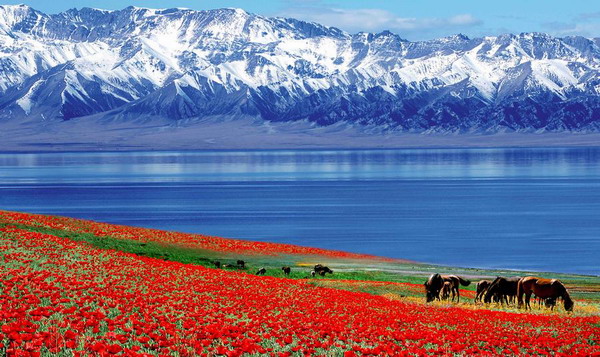
Undated file photo shows the spring scene of Sayram Lake in Huocheng county, Northwest China's Xinjiang Uygur autonomous region.[Photo/Xinhua] |
There are powerful sentences you might come across when living in China. One of them is:?China is too big. You got lost in narrow hutong alleys, the Chinese next to you can point north with the accuracy of a compass needle, but can’t say where the next public toilet is? You are stuck with the typical air pollution office talk on a grey Beijing morning or conversation over the correctness of China’s GDP growth figures? There is one sentence, which is never misplaced and has saved many an awkward moment –?China is too big.
It’s a sentence I was glad to use when I received an invitation from the?Bingtuan?(Xinjiang Production and Construction Corps), also known as XPCC, for a field study trip to Xinjiang. It was in 2013, my fifth year in China, I had not heard of the?Bingtuan?before and was rather embarrassed of my knowledge gap. However, one?shouldn’t look a gift horse in the mouth; I confirmed the trip and resolved to use it to fill all my?Bingtuan-related gaps.
The?Bingtuan?is an economic and paramilitary government organization in Xinjiang, which has administrative authority over several cities, settlements and farms. Founded in 1954 under the orders of Mao Zedong to develop border regions, it has a unique administrative structure, providing healthcare, education and other governmental functions for regions under its jurisdiction. After over fifty years of history, the?Bingtuan?runs its own hospitals, universities, TV stations, newspapers, etc. There are 37 ethnic groups represented, the largest of which are the Han (88.1%), Uyghur (6.6%), Hui (2.6%), Kazakh (1.7%), and Mongol (0.3%), as estimated by the?Bingtuan?in 2002.
Our airplane flew over the impressive mountain range of Tien Shan. We got on a bus and headed for Wujiaqu, a sub-prefecture-level city about 40 km north of Urumqi.?On a visit to the local middle school, a young student told me of his plans to travel around the world on his bicycle. That was the pre-Chinese dream era. We spent time on the farms,?looking at cotton fields and digging out yam roots. Some old women came to the fields driving on the back of an in-between vehicle, which bore some resemblance to a pickup truck. We were told they come to?steal-take-borrow?yam roots. The women belonged to an ethnic minority. They couldn’t understand a word of our Mandarin, studied under hardship, uncountable nights in cold libraries. They giggled instead and showed us some traditional dances. Their movements were so graceful, just a few steps away one could have taken them for beautiful young girls. Distance does lend enchantment to the view; their wrinkly faces looked like leather, tanned over decades below the Xinjiang sun. China is full of people like that.?
We drove to the desert, which lay in total silence before us. Playing cards and beer bottles were scattered here and there, the remains of a nightly get-together. The only sounds I could hear were some desert mice and my classmate sending a voice message on WeChat, leaving me with uncomfortable feelings about civilization.
The Austrian author Joseph Roth once wrote: “National and linguistic unity can be a strength, national and linguistic diversity is always one.” Despite daily meals of smoked horsemeat with salted milk tea, I was sad to leave Xinjiang, the region that seems monotonous and unexciting at first glance, but reveals diversity and uniqueness at closer look. I had the feeling that I could have looked a bit closer, but?China is too big. One can’t know all emperors, important party leaders, chengyu, etc. People want to know all the answers nowadays; there isn’t a place for mystery anymore. While China shows us the limitedness of our own knowledge, it reveals the power of mystery. That is why it is the best place to be dressed for success. All one needs is a tailored suit, a set of name cards and a pack of Chung Hwa smokes. I had none of these items in my luggage when I headed off to the?Bingtuan, so I?just brought back these memories.?
The original blog is at: http://blog.chinadaily.com.cn/blog-1354694-32136.html


Copyright 1995 - . All rights reserved. The content (including but not limited to text, photo, multimedia information, etc) published in this site belongs to China Daily Information Co (CDIC). Without written authorization from CDIC, such content shall not be republished or used in any form. Note: Browsers with 1024*768 or higher resolution are suggested for this site.
License for publishing multimedia online 0108263 Registration Number: 130349