 |
|
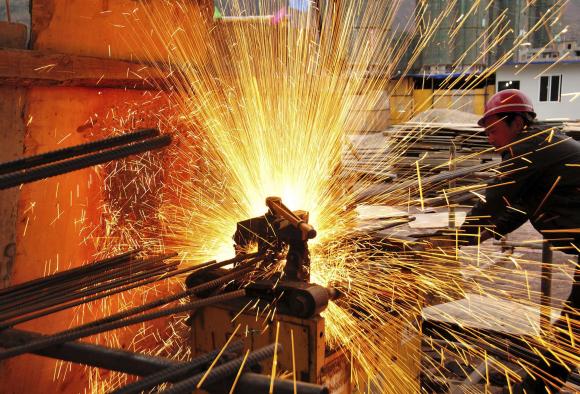
A worker welds at a construction site in Yiliang, Yunnan province, February 28, 2015.[Photo/Agencies] |
In the face of the tangible slowdown in national economic growth that began last year, it is necessary for the government to introduce some proactive fiscal and monetary policies to deal with looming deflation.
After witnessing fast growth for decades, the world's second-largest economy can accept its natural deceleration in a moderate manner, but when the growth is far below its potential growth rate, appropriate fiscal and monetary stimulation measures are needed. This requires correcting three misperceptions of the Chinese economy.
The first misperception is to put China's economic growth on the opposite side of its reforms: that the country must accept the inevitable slowing of economic growth as it advances needed reforms. However, the fact is almost all reforms can contribute to economic growth. For example, the substantial reforms the country has launched in the financial sector, which have basically realized a market-based pricing regime for interest rates, removed entry barriers to the financial market, and introduced some financial innovations, have forcibly spurred the development of high-tech enterprises.
Despite unavoidable short-term fluctuations, financial reforms are sure to more effectively bolster China's economic growth in the middle and long run. Another example is reform of the hukou, or household registration system, which can not only raise the welfare of a large number of people, but also stimulate consumption and drive national economic growth. And a recent pricing reform program worked out by the State Council, China's Cabinet, if implemented in a comprehensive manner, will certainly inject more vigor into the economy. Therefore, reforms propel growth not hinder it.
The second misperception of China's economy is that once the country adopts a proactive fiscal approach, it will return to an investment-dependent path as in the past. The reason for such a misperception is that some confuse counter-cyclical fiscal measures with structural adjustments. It is known that the current proactive fiscal measures embraced by the government are counter-cyclical and temporary while structural adjustments are a long process that cannot be achieved overnight. China's saving rate, for instance, has dropped by 4 percentage points over the past five years. Such a decline is very fast and we can expect further decline in the future.
Against the backdrop of its obvious economic slowdown, the implementation of proactive fiscal policies and increased investment will serve as the most direct means to push up the country's economic growth rate. Many believe that the efficiency of China's investment has been on the decrease and thus more investment is wasteful. Such an argument is essentially based on a wrong causal relationship. The declining rate of return on investment is a result rather than a cause of the decline in the economic growth rate. Capital is not fully utilized in economic downturn, so it is natural to find its returns decline.
A review of the past three decades shows the efficiency of investment is pro-cyclical. Any time economic growth is on the booming side, the country's investment efficiency will rise; vice versa. The current decline in China's investment efficiency is actually a byproduct of its economic downturn. And the use of a declining efficiency of investment to object to proactive fiscal policy is simply putting the cart before the horse.
The third misperception of China's economy is that monetary policies can be used as a means to promote economic structural adjustments. Actually, the goal of a country's monetary policies is to keep its economic growth in line with its potential growth rate while maintaining a relatively low inflation rate. In other words, monetary policy is to iron out economic fluctuations. Given that, monetary policies have to be universal so they are applied equally to all sectors of the economy. Their use for economic structural adjustments will inevitably lead to economic distortion.
The author is head of the National School of Development, Peking University.


I’ve lived in China for quite a considerable time including my graduate school years, travelled and worked in a few cities and still choose my destination taking into consideration the density of smog or PM2.5 particulate matter in the region.
Copyright 1995 - . All rights reserved. The content (including but not limited to text, photo, multimedia information, etc) published in this site belongs to China Daily Information Co (CDIC). Without written authorization from CDIC, such content shall not be republished or used in any form. Note: Browsers with 1024*768 or higher resolution are suggested for this site.
License for publishing multimedia online 0108263 Registration Number: 130349