Confucian governance links past with present
 |
|
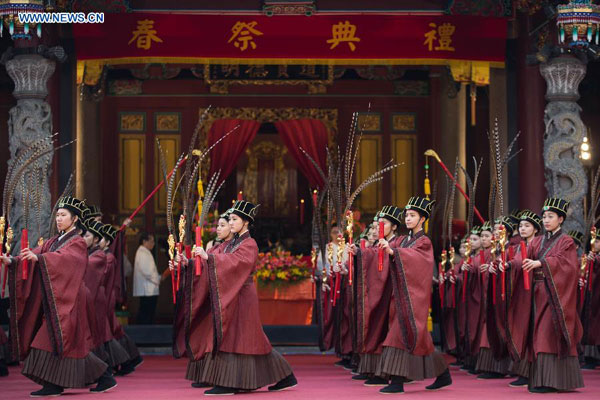
Performers participate in a spring homage ritual at the Confucius Temple of Taipei, southeast China's Taiwan, March 22, 2015. A spring homage ritual was held here to honour Confucius (551-479 BC), a Chinese teacher, politician and philosopher. [Photo/Xinhua] |
No nation can pursue modernization by giving its traditional culture a complete burial, as China once attempted half a century ago. But how can China's governance benefit, for example, from the more than 2,000-year-old Confucianism? China Daily's Zhang Zhouxiang recently interviewed Yao Zhongqiu (pen name Qiu Feng), a senior professor of humanity studies at Beihang University and one of the leading scholars in Confucianism, for his opinion on the subject.
Question: Some critics say Confucianism serves dynastic rule, which repressed society. If that is the case, would Confucianism be of any value today?
Answer: That criticism is too simplistic. How can a cultural/moral system that has lasted more than 2,000 years docilely serve the powers that be?
Q: How did Confucian scholars stick to their principles throughout the long history of dynastic rule?
A: While societies in Western Europe and North America had the chance to write their constitutions and build new governments, in ancient China, what scholars could do was to keep arguing on behalf of the Tao, or the ideal way to govern. They never stopped arguing that a ruler, whoever he was, must practice the Tao, or he would risk losing his legitimacy. That was their way of offering guidance to politics.
Q: What would you tell our non-Chinese readers was the unique feature of their arguments, justice, individual freedom or, as some other people saw it, an entirely different set of concepts focusing on the collective or the community?
A: All lasting moral arguments share universal elements. The uniqueness in the Confucian, or the Chinese, argument is the demand for evenness, fairness and public-ness for the good of humanity or, as what they then said, of all people under the heaven. It would be too simple to call it collectivism.
- Confucianism is needed in people's daily lives, scholars say
- Over 150 scholars attend Confucianism meeting
- Money cannot buy real Confucianism philosophers
- The rebirth of Confucianism
- Researchers compile complete works of Confucianism
- Confucianism not rural priority
- Culture Insider: How Confucianism shaped China