 |
|
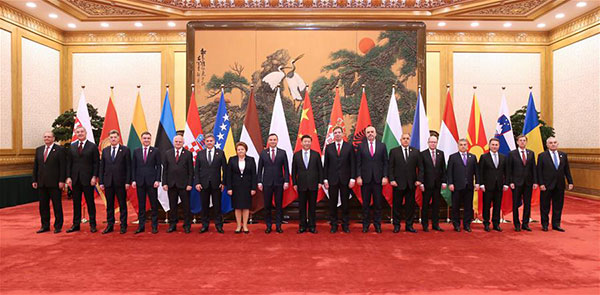
Chinese President Xi Jinping (9th L) poses for a group photo with leaders attending the 4th Summit of China and Central and Eastern European (CEE) countries, in Beijing, capital of China, Nov. 26, 2015. [Photo/Xinhua] |
A big question people have been asking since China's leaders propounded the concept of Chinese Dream in 2012 is: What is the symbol of the Chinese nation's rejuvenation? Now we can say that the revival of the Silk Road is that symbol, not only for the rejuvenation of the Chinese nation, but also the rejuvenation of European, Asian and African nations, because it integrates the Chinese Dream with the dream of the world.
The Silk Road Economic Belt and the 21st Century Maritime Silk Road, known together as the Belt and Road Initiative, is aimed at solving the development problems of China, and help the world seek solutions to some common problems faced by humankind today.
Although the Belt and Road Initiative is expected to benefit the peoples along the two routes, different parties have different opinions about it. All the provinces in China see the initiative as a big opportunity to boost their economic growth and restructuring. On the other hand, many foreign countries expect to gain from working with China. And some have misunderstandings that have to be corrected.
The initiative is not meant only to encourage Chinese enterprises to explore and exploit the global market, even if many of them are already eyeing the 64 countries and regions along the two routes as their investment targets. But it is a misconception that the initiative is meant to transfer China's overcapacity to other countries, because it seeks industrial cooperation, so as to transform the "Made in China" label to "Made by China".
Earlier, China tried to introduce the advanced technologies, management models and global rules of development countries to the domestic market. Now, it hopes to localize its technologies and rules in foreign countries. Chinese enterprises are expected to not only establish foreign branches, but also localize their research and design, as well as production around the world.
Also, some Chinese experts have tried to equate the Yangtze River Economic Belt or the Internet-Plus strategy with the Belt and Road Initiative. But these three strategies are distinct from each other. The key word of the Belt and Road Initiative is interconnectivity, so it should not become a convenient slogan for Chinese local governments to beautify their industrial or regional development policies.
The Belt and Road Initiative is not a new opening-up strategy either. Instead, it is a new strategic framework of China's neighborhood diplomacy through the opening-up. The essence of opening-up is to change from "inviting in" to "going out", seek a new dynamic balance between the two and strengthen global economic cooperation and competition.
Broadly speaking, China's opening-up today should help it develop its vast western and southwestern regions. Also, its aim should be to implement the country's free trade area strategy, and promote free flow of commodities, capital and labor around the world.
The Belt and Road Initiative, free trade area strategy, the Yangtze River Economic Belt and the integrated development of Beijing, Tianjin and Hebei province form China's comprehensive opening-up pattern.
More importantly, the Belt and Road Initiative should not be equated with foreign aid. Many Chinese are worried that large-scale foreign aid expected to flow into China because of the Belt and Road Initiative will lead to a government debt crisis at a time when many domestic problems remain to be solved. Yet the initiative is aimed at ensuring China's sustainable development and progressively decrease the effects of globalization on the country.
The initiative signals China's active involvement in building a new trend of globalization, rather than only looking for opportunities to seek profits from it. It is China that is now promoting the integration of Eurasia, and trying to make trade and investment more convenient, deepen economic and technological cooperation, and develop free trade areas, in order to help build a grand Eurasian market.
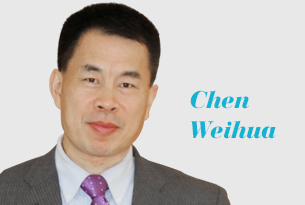
The author is a researcher in international relations at the Beijing-based Renmin University. The article is firstly published on People's Daily on Nov 25.


I’ve lived in China for quite a considerable time including my graduate school years, travelled and worked in a few cities and still choose my destination taking into consideration the density of smog or PM2.5 particulate matter in the region.
Copyright 1995 - . All rights reserved. The content (including but not limited to text, photo, multimedia information, etc) published in this site belongs to China Daily Information Co (CDIC). Without written authorization from CDIC, such content shall not be republished or used in any form. Note: Browsers with 1024*768 or higher resolution are suggested for this site.
License for publishing multimedia online 0108263 Registration Number: 130349