When Japan's economy grew at an annual rate of 10 percent in the 1960s, air pollution in several cities was alarming. Emissions of nitrogen dioxide, carbon monoxide and sulfur dioxide tripled, causing the pollution-related illnesses such as Yokkaichi asthma and Minamata disease (mercury poisoning)-both named after the cities where they first appeared-and cadmium poisoning.
It was the oil crisis in the 1970s that catalyzed the rapid turnaround that allowed Japan to become an "efficiency superpower".
Japan charted a clear course and gave marching orders to its bureaucracy. What followed was a wholesale reorganization of the government's attitude toward energy security and a nationwide effort to reduce energy consumption, and promote better conservation and efficiency. By harnessing the conservation efforts of millions of households and businesses, Japan succeeded in restraining the growth in its energy consumption even as its economy continued to expand throughout the 1980s and 1990s. By most estimates, Japan leads the world today in energy efficiency.
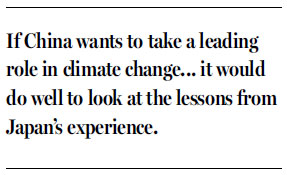
To some extent, Japan has cleaned itself up through a shift to lighter manufacturing and allowing its companies to move much of their energy-intensive primary processing to other countries while concentrating on high-tech products further up the value chain. China can still learn from Japan how to become more energy efficient and how to protect its environment from rapid industrialization.
Japan provided China with loans for several years to put toward important environmental initiatives, such as installing desulfurization and dust collection systems at ironworks, building water supply systems and constructing sewage networks. Japan's support and experience mean a lot to China.
And there is plenty of room for the two countries to strengthen their cooperation in energy saving and environmental protection.
China is thirsty for Japan's advanced environmental technologies, and China remains a big, relatively cheap laboratory for Japanese companies to do research and development.
China frequently sees many of its cities wreathed in choking smog and has to deal with other severe environmental problems, while Japan is still struggling to move out of recession. So this is would be a win-win proposition.
The author is China Daily's Tokyo bureau chief.
caihong@chinadaily.com.cn


I’ve lived in China for quite a considerable time including my graduate school years, travelled and worked in a few cities and still choose my destination taking into consideration the density of smog or PM2.5 particulate matter in the region.
Copyright 1995 - . All rights reserved. The content (including but not limited to text, photo, multimedia information, etc) published in this site belongs to China Daily Information Co (CDIC). Without written authorization from CDIC, such content shall not be republished or used in any form. Note: Browsers with 1024*768 or higher resolution are suggested for this site.
License for publishing multimedia online 0108263 Registration Number: 130349