 |
|
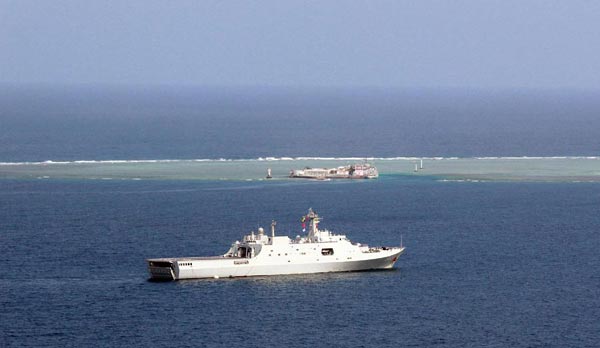
A formation of the Nanhai Fleet of China's Navy on Saturday finished a three-day patrol of the Nansha islands in the South China Sea. [Photo/Xinhua] |
The hearing on the merits of the South China Sea arbitration case further reveals the true colors of the Philippines. The truth about the "Emperor's New Clothes" is out. During the hearing, the Philippines made a big fuss about China's sovereignty over the South China Sea Islands and went out of its way to negate China's territorial sovereignty. This fully demonstrates that the South China Sea dispute between China and the Philippines is, in essence, a dispute about territory. The only motive and objective of the Philippines' initiation of the arbitration is to deny China's sovereignty over the South China Sea Islands. But no matter how this "arbitration" farce continues to play out, China's sovereignty over the South China Sea Islands brooks no denial.
In disregard of basic historical facts, the Philippines falsely claims that the Chinese people historically have carried out few activities and have had no presence in the South China Sea, and China never has sovereignty over the South China Sea Islands. History, however, brooks no denial. The South China Sea Islands have been China's territory since ancient times. Successive Chinese governments have exercised continuous jurisdiction over the islands by means of administrative control, military patrol, production and business operations, and maritime disaster relief, among others. After the Japanese war of aggression against China, Japan occupied China's Xisha and Nansha islands. Following its victory in the war, China sent warships to recover the Xisha and Nansha islands, and garrisoned troops and built various military and civilian facilities on the islands, thus resuming exercise of sovereignty over the South China Sea Islands de jure and de facto.
Disregarding its untold suffering and devastation inflicted by the Japanese militarist aggression during the Second World War, the Philippines unexpectedly claimed the Cairo Declaration and the Potsdam Proclamation not legally binding. As a matter of fact, these two documents are important international legal instruments published during the Second World War, and form the bedrock of the post-war international order in East Asia. It is clearly stipulated in the two documents that Japan shall return the Chinese territory it had stolen from China. In the document on normalization of its diplomatic ties with China, Japan also made explicit commitment to complying with the relevant provisions of the Potsdam Proclamation. Some members of the Philippine authorities, out of their smug calculation of territorial expansion, have turned a blind eye to historical facts and gone so far as to seek selfish interests at the expense of the feelings of the Philippine people and the fruits of the World Anti-Fascist War. This only exposes the shortsightedness of these Philippine politicians, who could have no bottom line at all even in pursuit of just a few petty interests.
The Philippines erroneously claims that the Nansha Islands have been "terra nullius" since the end of the Second World War, saying that the San Francisco Peace Treaty signed in 1951 only asked Japan to give up its rights and claims on the Nansha Islands without clarifying that the islands should be returned to China. First of all, China does not recognize the San Francisco Peace Treaty. Secondly, China has all along enjoyed sovereignty over the South China Sea Islands; it restored the jurisdiction over the Nansha Islands after the Second World War through a series of actions, or in another word, the Nansha Islands have been returned to their original owner. In this sense, the Nansha Islands have always been China's territory. How can they become "terra nullius"? Fabrication of the excuse of "terra nullius" only lays bare the Philippines' territorial expansionism and insatiable greed.
In essence, the South China Sea dispute between China and the Philippines is a territorial dispute between the two countries caused by Philippines' illegal occupation of some islands and reefs of China's Nansha Islands after the 1970s. China and the Philippines have on many occasions reached consensus on resolving the relevant dispute through negotiations and consultations. To push ahead with the arbitration, the Philippines broke its promises, and disguised the dispute into one over the so-called "interpretation and application of the UNCLOS". Once the disguise is removed, however, people will see clearly the essence and root cause of the dispute. What does the dispute between China and the Philippines over the Nansha islands and reefs have to do with the interpretation and application of the UNCLOS? The unilateral initiation of the arbitration is an out-and-out political provocation under the cloak of law. The ulterior motive of the Philippines is to snatch China's territory through a farce like this.
Nevertheless, the determination of the Chinese people to safeguard its territorial integrity is as firm as a rock. Only the Chinese people have the final say when it comes to China's territory. Any attempt to negate China's sovereignty, rights and interests through a so-called "arbitration award" will be nothing but wishful thinking, just like flowers in a mirror and reflection of the moon in water. By going back on its own words and confusing the concepts for the purpose of territorial expansion, the Philippines will only end up bringing disgrace on itself.
The author is a researcher on international studies.


I’ve lived in China for quite a considerable time including my graduate school years, travelled and worked in a few cities and still choose my destination taking into consideration the density of smog or PM2.5 particulate matter in the region.
Copyright 1995 - . All rights reserved. The content (including but not limited to text, photo, multimedia information, etc) published in this site belongs to China Daily Information Co (CDIC). Without written authorization from CDIC, such content shall not be republished or used in any form. Note: Browsers with 1024*768 or higher resolution are suggested for this site.
License for publishing multimedia online 0108263 Registration Number: 130349