 |
|
LI MIN/CHINA DAILY |
From June 1 it has begun to feel like public health might be starting to win out in the battle against tobacco in Beijing. The Beijing smoke-free law now makes it illegal to light up in workplaces, restaurants, hotels and other public spaces across the city. But the battle against tobacco is far from over. Tobacco products still kill thousands of Chinese people every day.
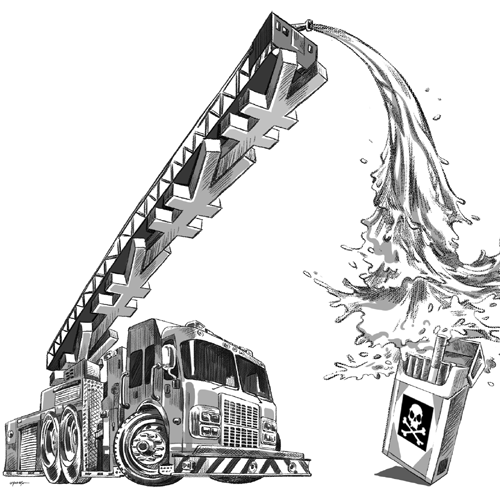
There is a way to combat this, though: tobacco tax. Quite simply, a big enough tax increase could save millions of lives in the next decade.
Tobacco use significantly contributes to a fast growing epidemic in China: non-communicable diseases such as heart attacks, strokes, cancer and chronic pulmonary diseases. These conditions are now the leading causes of premature death, ill health and disability in China, accounting for more than 80 percent of total annual deaths. If tobacco use is not significantly reduced, it will aggravate the economic and social impact of an aging population, increasing the odds of a future economic slowdown, which in turn will pose a significant social challenge.
Experience from many other countries shows that not only is tobacco tax an effective means to reduce tobacco consumption and associated healthcare costs, it can also provide significant revenue which can be reinvested into other priorities.
The Philippines is a great example of how tobacco taxes are "win-win". The 2012 Philippines "Sin Tax" Law has raised and simplified tobacco and alcohol excises, increased government revenues and reduced smoking. Retail prices of cigarettes increased significantly, with early data suggesting a decline in smoking prevalence.
Despite the decline in volume, revenue still increased - nearly doubling the Philippines' Department of Health's budget. This enabled fully subsidized health insurance to be provided to the poorest 40 percent of the population - 14 million families, or approximately 45 million people.
In May 2015, China's Ministry of Finance announced an increase in tobacco taxation, of 0.005 renminbi per individual cigarette, alongside an increase in the wholesale tax rate. Importantly, this tax increase is flowing onto retail prices - making cigarettes a little more expensive across China as a result.
This tax increase adopted by the government of China, in line with its commitment to the World Health Organization's Framework Convention on Tobacco Control, is an important step in the right direction. However, it is only one step. As the recently released 2015 WHO Report on the Global Tobacco Epidemic points out, tobacco taxes must be increased regularly in order to reduce tobacco use. Otherwise, if incomes rise more quickly than inflation, the relative cost of tobacco products can actually decrease over time.
This has been the case in China over the last decade as the economy has grown, incomes have increased, and tobacco products have become more affordable. Compared with the progress made in other BRICS (Brazil, Russia, India, China and South Africa) countries, China is lagging behind in raising tobacco taxes.
Higher tobacco taxes not only help smokers quit, but crucially they also prevent the next generation from taking up smoking in the first place. The vast majority of smokers start smoking when they are young. Higher tobacco taxes make cigarettes much less affordable for teenagers, helping to protect the coming generations from tobacco disease and death.
If tobacco control measures are not strengthened with steeper tobacco tax increases, China's non-communicable disease epidemic will continue to explode over the next 20 years. This really has the potential to undermine the Chinese government's agenda for harmonious and human-centred development, particularly by aggravating health inequities.
The WHO and the World Bank Group stand ready to support the government of China in advancing the tobacco taxation agenda. A healthy future for China depends on it.
Bernhard Schwartlander is WHO China representative, and Bert Hofman is World Bank's country director for China, Mongolia and South Korea.


I’ve lived in China for quite a considerable time including my graduate school years, travelled and worked in a few cities and still choose my destination taking into consideration the density of smog or PM2.5 particulate matter in the region.
Copyright 1995 - . All rights reserved. The content (including but not limited to text, photo, multimedia information, etc) published in this site belongs to China Daily Information Co (CDIC). Without written authorization from CDIC, such content shall not be republished or used in any form. Note: Browsers with 1024*768 or higher resolution are suggested for this site.
License for publishing multimedia online 0108263 Registration Number: 130349