 |
|
Luo Jie/China Daily |
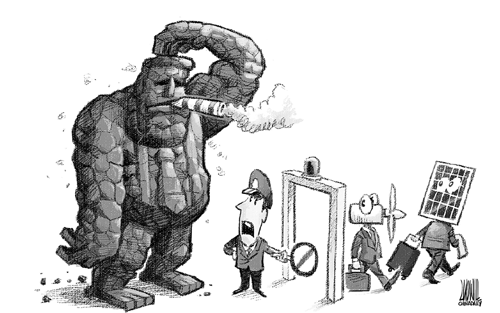
The steel industry, coal burning and growing factories around cities are the main factors causing dense smog in North China, the Ministry of Environmental Protection said on Dec 14. North China, except Beijing and Tianjin, gets 90 percent of its energy by burning coal, which contributes about 60 percent of PM 2.5, airborne inhalable pollutant particles with a diameter less than 2.5 micrometers.
Unlike previous occasions, this time the ministry did not blame automobiles, burning of coal and wood for cooking, smoking of meat, or burning of stalk for causing air pollution. Governments at all levels, therefore, should better target their anti-PM 2.5 measures at reducing the consumption of coal and emissions from polluting industries.
That said, if the interest groups behind the polluting industries cannot feel the pain of the government's anti-air pollution measures, breathing fresh air in the seriously affected areas of North China will remain just wishful thinking.
Now that the ministry has made it clear what causes smog, the governments should waste no time in identifying the main local polluters. More importantly, officials in all the 22 seriously affected cities in North China should take coordinated actions to reduce emissions, and replace coal with clean energy.
Beijing has moved all its polluting industries to neighboring Hebei province. But that has not made a big difference to Beijing's air quality. Only when several provinces in the region suspended large parts of their industrial productions and construction projects, and halved the number of cars on the roads at the same time could North China enjoy blue skies. These "extreme measures" were taken in November 2014 for the Asia-Pacific Economic Cooperation meeting in Beijing, and in September this year for the military parade to mark the 70th anniversary of the victory in the anti-fascist war.
However, there is widespread concern that cutting the production of steel and reducing the use of coal will hurt the economy. But the fact is, China's steel industry suffers from overcapacity, and its energy-use efficiency is much lower than developed countries' when it comes to burning coal.
China produces nearly half of the world's crude steel. Last year, its crude steel output was 1.13 billion tons, up 4.46 percent year-on-year, but its consumption fell 2.25 percent year-on-year to 737 million tons. Although China' s steel exports in 2014 increased to 94 million tons, up 50 percent year-on-year, it did not lead to a proportionate rise in profit because of the low price of steel and high prices of raw materials. Also, the steel industry's emissions, energy consumption and negative impact on the environment are comparatively high.
Hence, reducing the steel industry's scale will not only boost economic growth and reduce emissions, but also stimulate the reform of the industry to make it more focused on quality, rather than quantity.
Chinese experts, on their part, should conduct more specific and professional studies to find the best way of solving the pollution problem, instead of telling people it will take another 20 to 30 years to clean up the air.
The experience of developed countries shows air quality improves with the upgrading of the energy consumption structure. So the Chinese government should expedite the process of replacing coal with energy from the sun, wind, water, nuclear and other clean sources.
Indeed, the government has already taken measures to promote new energy, innovation and relocation of industries, which, if well implemented, will have a positive effect on environmental preservation.
But the authorities should be vigilant to the polluting industry's relocation to China's inland areas in the upper reaches of the country's main rivers, because the ecology there is more fragile, and ecological or environmental degradation even in a small area can have national consequences.
The article was first published on China.com.cn on Dec 19.


I’ve lived in China for quite a considerable time including my graduate school years, travelled and worked in a few cities and still choose my destination taking into consideration the density of smog or PM2.5 particulate matter in the region.
Copyright 1995 - . All rights reserved. The content (including but not limited to text, photo, multimedia information, etc) published in this site belongs to China Daily Information Co (CDIC). Without written authorization from CDIC, such content shall not be republished or used in any form. Note: Browsers with 1024*768 or higher resolution are suggested for this site.
License for publishing multimedia online 0108263 Registration Number: 130349