 |
|
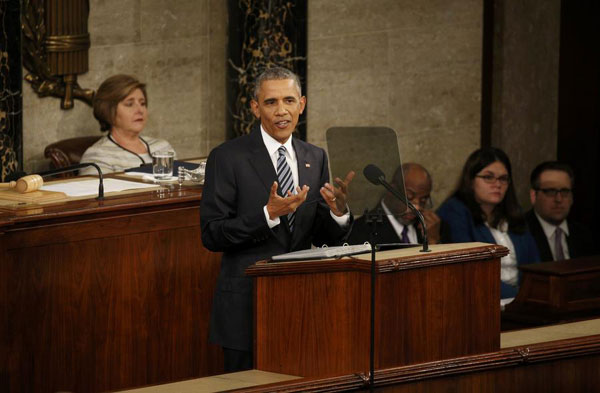
US President Barack Obama delivers his State of the Union address to a joint session of Congress in Washington, January 12, 2016. [Photo/Agencies] |
After President Obama delivered his final State of the Union address on January 12, Republicans who are running to replace him quickly dismissed his speech as a political flackery, saying it represented the current administration's failures and pledging that they would do better. It is true that Obama offered a familiar reassurance that the United States is expending enormous effort to protect its people against international terrorism. He also tried to convince Americans that their country is embracing an optimistic view of the future, contrasting with the gloomy portrayals offered by his Republican opponents.
While watching Obama's State of the Union speech on live TV, it was clear to me that Republicans would be unimpressed with whatever Obama told the nation. During the address, I monitored the real-time reaction to Obama's speech on Microsoft Pulse, an audience response system providing American viewers the ability to respond every five seconds, and as often as they want, to Obamas' speech on live TV. The engagement technology showed that the red line representing Republicans' opinions remained the lowest all the time, compared with the yellow line representing the response from the Independent and the blue line the response from Democrats.
But to most Americans, Obama's speech represents a decisive moment for the two-term president. Free from more campaigns, Obama seems to find his voice. He dropped a long list of proposals that often languished in Congress like he did in the previous State of the Union addresses. Instead he focused on quelling the fears among Americans by telling them the U.S. economy is getting better and the government is doing a good job in fighting terrorism. Obama knows well that this was the last chance of catching the attention of the largest television audience left in his presidency. He must make best use of the watershed night to frame the debate about who should replace him, and more importantly, where the country should go from here.
It is evident Obama's last State of the Union speech also offers him a good chance to define his presidential legacy, which may leave a profound mark in the U.S. history. If the legacy Obama leaves behind is powerful enough, it will surely challenge his immediate successor and future presidents to keep addressing the issues he deems most vital.
In the past seven years, Obama knows that his popularity did not go as high as he hopes. How Obama is regarded in history after he leaves the White House depends a lot on how he defines his legacy starting now. Delivering the last State of the Union serves as the first step in defining Obama's legacy.
Listening to his speech, I know some serious homework had been done, which was not a secret. The White House announced that working on this State of the Union speech was Obama's top priority in the past weeks, bringing tremendous pressure on his aids, in particular, Cody Keenan, Obama's chief speechwriter, and Jennifer Psaki, the White House Communication Director.
Part of Obama's homework may include referring to the last State of the Union address President Ronald Reagan made in January 1988. I thought of this when Obama quoted President Abraham Lincoln's Gettysburg address in 1864, "that government of the people, by the people, and for the people." That's what exactly Reagan did in his 1988 speech.
Many other similarities exist between the two addresses. In their last important speeches, both Reagan and Obama advocated trade deals and open markets. Reagan wanted to strike a deal with Canada, Mexico and other countries, saying: "Our goal must be a day when the free flow of trade, from the tip of Tierra del Fuego to the Arctic Circle, unites the people of the Western Hemisphere in a bond of mutually beneficial exchange, when all borders become what the U.S.-Canadian border so long has been: a meeting place rather than a dividing line." Today, on the same Hill, Obama promoted the recent Trans Pacific Partnership as a way to boost trade with other countries, including some of the same Western countries Reagan envisioned.
Back in 1988, the U.S. economy had seen a drop in the unemployment rate and the federal deficit. In his speech, Reagan quickly emphasized, "We have worked together to bring down spending, tax rates, and inflation, employment has climbed to record heights; America has created more jobs."
Last week, Obama cited similar basic facts of the U.S. economy: "We're in the middle of the longest streak of private-sector job creation in history. More than 14 million new jobs; the strongest two years of job growth since the '90s; an unemployment rate cut in half.... And we've done all this while cutting our deficits by almost three-quarters."
In education, Reagan praised the rising test scores among American children, which he largely attributed to the education reforms spearheaded by his administration. Obama talked about high school graduation rates reaching an all-time high. Reagan listed merit pay for great teachers, a stronger curriculum, and local control of schools rather than too much supervision by the Federal government. Obama promoted the bipartisan reform of No Child Left Behind that increased local control. He also urged to recruit more great teachers and provide better training to teachers.
On issues of government assistance, Reagan had this to say: "Let's start making our welfare system the first rung on America's ladder of opportunity, a boost up from dependency, not a graveyard but a birthplace of hope." About 30 years later, Obama said, "Say a hardworking American loses his job? -- we shouldn't just make sure he can get unemployment insurance; we should make sure that program encourages him to retrain for a business that's ready to hire him."
Finally, on major foreign policy initiatives, Obama boosted a nuclear arms deal with Iran, while in 1988, Reagan highly spoke of the INF Treaty he negotiated with the Soviet Union.
To most Democrats and Republicans, Reagan has been viewed as one of the most popular presidents in the U.S. history, not just in the 20th Century. Seeing Reagan's glittering legacy, Obama surely hopes to follow suit to build up his own legacy. Given Obama's lagging poll ratings and ample negative narratives, it is too early to know how successful Obama can define his legacy. But from his last State of the Union address, it is clear to Americans that a shoddy presidential legacy is the last thing Obama wants.
The author, Dr. Zhong Bu, Associate Professor from College of Communications, Pennsylvania State University


Copyright 1995 - . All rights reserved. The content (including but not limited to text, photo, multimedia information, etc) published in this site belongs to China Daily Information Co (CDIC). Without written authorization from CDIC, such content shall not be republished or used in any form. Note: Browsers with 1024*768 or higher resolution are suggested for this site.
License for publishing multimedia online 0108263 Registration Number: 130349