 |
|
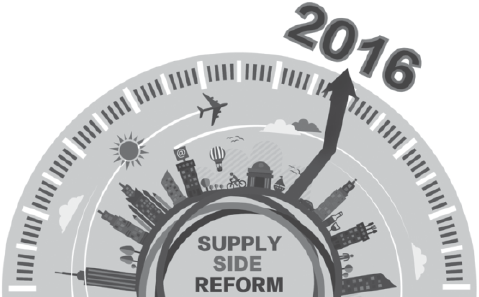
MA XUEJING/CHINA DAILY |
Given China's current economic conditions, a large-scale stimulus to strengthen the demand side will not help mitigate the downward economic pressure; instead, it will exacerbate its overproduction and environmental degradation problems.
And since the problems China faces are not short term, cyclical or caused by external factors, the use of methods focused on demand management cannot eradicate them from the roots. The need, therefore, is to address the problems that are putting added medium-and long-term structural and internal pressures on its healthy and sustained economic development.
Like two sides of a coin, supply and demand constitute two parts of the theoretical base of economics. As two modern practices of supply-side economics, "Reaganomics and Thatcherism" (the economic policies of former US president Ronald Reagan and former British prime minister Margaret Thatcher) once realized success in economic reforms through tax cuts, privatization of state-owned enterprises and reduced government intervention in the market.
But since China has achieved economic success by sticking to its own development path, its current push for supply-side reform is not-meant to duplicate Western practices; rather it is focused on how to power economic growth and push for innovation-driven development by comprehensively deepening reform.
With the push for the supply-side structural reform, China aims to double its GDP by 2020 from the 2010 level, which means achieving an annual economic growth of 6.5 percent or more. The pursuit of a higher quality and more efficient supply system is actually a continuation of the efforts the Third Plenum of the 18th Communist Party of China Central Committee vowed in November 2013 to make for "comprehensive and deepened reform".
The core of supply-side reform is structural reform whose key task is to streamline enterprises and promote industrial adjustment through optimization of the internal structure which involves technologies, brands, quality and services. By curbing overcapacity, helping enterprises lower their costs, reducing real estate inventories and preventing financial risks, China can realize a long-anticipated industrial structural adjustment.
Supply-side reform is not only industrial structural reform. From a long-term perspective, it will focus more on issues such as the workforce, land, capital and innovation. For example, by reforming the family planning policy to allow all couples to have two children, the authorities hope to add 2 million more children to the population every year and thus increase consumption by 70 billion yuan ($10.64 billion), which as a new-demographic dividend can become a driver of China's economic growth.
The reform of hukou (household registration system) and the real estate sector aimed at promoting trans-regional flow of personnel is expected to help about 100 million more people settle down in cities and towns, which will help push forward China's urbanization drive and increase supplies. The land reform to allow the transfer of rural land-use rights on a trial basis also has huge potential for the utilization of rural land for market dividends under the purview of law.
The key to successful "supply-side reform" lies in systematic innovation. But such an internal and structural systematic innovation and reform are usually a difficult and complicated task. So, economic growth should not be the only target of reform. The effects of reform are also related to such systematic factors as whether some substantial improvements are made in governance, market operation and the rule of law.
The public-private partnership, as an important component of the ongoing effort to facilitate supply-side reform, is yet to be reformed. And the different ways different departments see the reform will have negative influences on the market. The disadvantages that private capital faces in competing with State capital, partly because of their relationships with the government and their different financing capability, could make many aspects of the public-private partnership go against China's original intention of according private players a larger playing field. Like the Belt and Road Initiative, the push for supply-side reform is also vital for China to avoid the "middle-income trap". And the two initiatives together will contribute to the realization of the Chinese Dream for the Chinese people.
The author is a member of China Society of Economic Reform.


I’ve lived in China for quite a considerable time including my graduate school years, travelled and worked in a few cities and still choose my destination taking into consideration the density of smog or PM2.5 particulate matter in the region.
Copyright 1995 - . All rights reserved. The content (including but not limited to text, photo, multimedia information, etc) published in this site belongs to China Daily Information Co (CDIC). Without written authorization from CDIC, such content shall not be republished or used in any form. Note: Browsers with 1024*768 or higher resolution are suggested for this site.
License for publishing multimedia online 0108263 Registration Number: 130349