 |
|
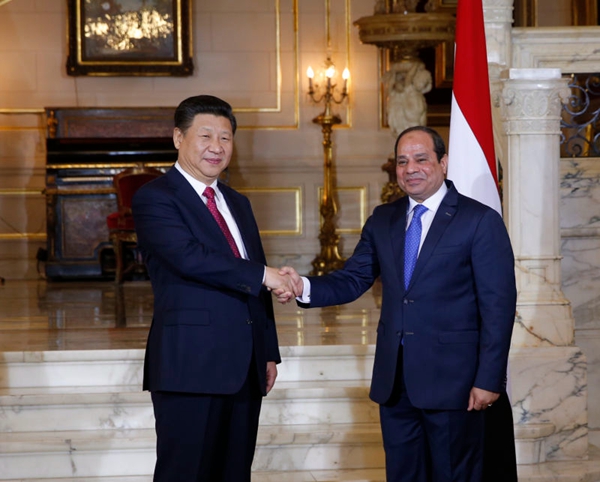
Chinese President Xi Jinping (L) holds talks with Egyptian President Abdel-Fattah al-Sisi at Quba Palace in Cairo, Egypt, Jan 21, 2016. [Photo/Xinhua] |
Editor's note: The article is an excerpt of the Evaluation Report on the Security Situation in Surrounding Areas of China (2016), issued by the National Institute of International Strategy of the Chinese Academy of Social Sciences.
In all likelihood, the geopolitical competition in China's neighborhood will intensify in the near future, constraining the country's ambition to press ahead with its Belt and Road Initiative, as many major regional players have carried out fresh strategies in response to the changing international situation and economic realities.
That includes the United States' rebalancing to the Asia-Pacific, the Russia-led Eurasian Economic Union, India's Act East Policy, and Indonesia's Global Maritime Axis; which could either be boons to China's grand transnational project the Belt and Road Initiative, or a latent strategic threat.
Among all, the joint efforts by Washington and Tokyo to contain China's robust rise, are particularly noteworthy, as well as the fact that influential regional powers tend to stay relatively cautious and conservative in participating in the implementation of the Silk Road Economic Belt and 21st Century Maritime Silk Road.
In general, the China-US relationship in 2015 features the coexistence of cooperation and competition, while both sides are poised to endure tougher strategic competition in the Asia-Pacific region.
On the security and economic front, Washington has doubled its efforts to implement its rebalancing and the Trans-Pacific Partnership Agreement, and refused to join the Beijing-launched Asian Infrastructure Investment Bank.
It also shows little interest in the Belt and Road Initiative: politicians rarely speak of it in public, while many China observers remain suspicious of its strategic implications, fearing that a rising China may threaten the US' global leadership.
Likewise, Japanese Prime Minister Shinzo Abe has also refrained from endorsing it; instead he has proposed expanding Japan's exports of infrastructure equipment, and Japan is investing $110 billion over the next five years to aid infrastructure building in Asia. The intensifying battle to sell high-speed rail to some Asian neighbors such as Thailand, for example, has become a proxy for the broader competition between Japan and China.
The US' security advantages and Japan's economic might, to some extent, have not only enhanced their cooperation and their hampering of China's Belt and Road projects, but also emboldened some of the US' military allies in the region to exacerbate territorial disputes with China, such as the Philippines' baseless South China Sea arbitration.
The fierce competition between China and Japan over a currently halted $5.5 billion deal (won by China), which involves a high-speed railway linking Jakarta and Bandung in Indonesia, was partly politicized and a reminder of the complicated situation Chinese investors have to deal with in overseas markets.
India, a populous neighbor and a global software front-runner, is hardly better. It recently approved a Japanese bid to build a high-speed line between Mumbai and Ahmedabad, and has done little to fulfill its promise to facilitate the construction of the Bangladesh-China-Myanmar-India economic corridor.
The good news is, Moscow and Beijing have reached a consensus on linking up their respective strategies - the Eurasian Economic Union and the Belt and Road Initiative - under the framework of the Shanghai Cooperation Organization.
Like most non-regional leaders, Central Asian countries such as Kazakhstan and Kyrgyzstan are inclined to maximize their interests with an eye on the relationships between major powers. They basically welcome China's trans-Eurasian project and seek to expand their presence after China and Russia agreed to cooperate.
That being the case, China needs to keep pursuing their support and stay alert to the meddling of major powers, especially the US-Japan alliance, to protect its national interests. Of course, it should keep an open mind to cross-border cooperation, take into consideration all potential risks in its overseas investments, and avoid overly politicizing them.


I’ve lived in China for quite a considerable time including my graduate school years, travelled and worked in a few cities and still choose my destination taking into consideration the density of smog or PM2.5 particulate matter in the region.
Copyright 1995 - . All rights reserved. The content (including but not limited to text, photo, multimedia information, etc) published in this site belongs to China Daily Information Co (CDIC). Without written authorization from CDIC, such content shall not be republished or used in any form. Note: Browsers with 1024*768 or higher resolution are suggested for this site.
License for publishing multimedia online 0108263 Registration Number: 130349