 |
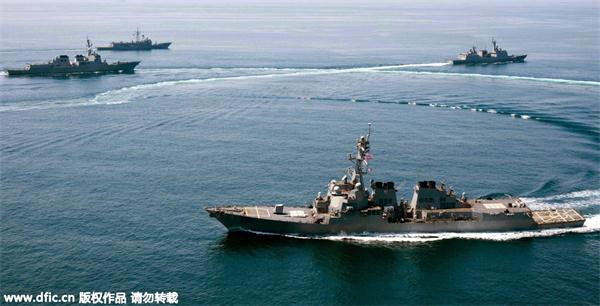
| The guided-missile destroyer USS Lassen (front) conducts a trilateral naval exercise with the Turkish and South Korean Navy on May 25, 2015. [Photo/IC] |
The first US-ASEAN meeting was hosted by US President Barack Obama at Sunnylands Rancho Mirage in California on Monday and Tuesday, the same venue where US President Barack Obama had his first informal meeting with Chinese President Xi Jinping in 2013.
Considering there are territorial disputes between China and some of the members of the Association of Southeast Asian Nations, the meeting and its location attracted much speculation.
To some in the US, the meeting should be seen as a milestone in relations between the United States and ASEAN, as it is a concrete step in implementing the US' rebalancing to the Asia-Pacific given the importance of ASEAN's role in the strategy.
Whether the US-ASEAN meeting will become a milestone in this respect is doubtful. For starters, although Obama is pushing the rebalancing strategy, there is limited time left for him. It is impossible to expect lots of promises to be put into practice within a year with the "poisonous political climate"-as Obama has described it-in the US. The next US president, especially if Republican, may not follow up on the promises made at the meeting.
On the ASEAN side, not all ASEAN members want to side with the US against China. The Philippines and Vietnam are among the countries involved in territorial disputes with China in the South China Sea. But Philippine President Benigno Aquino III's six-year term in office will end in mid-2016. The future president may change his attitude toward China and pursue more rational and diplomatic ways to resolve their dispute. In Vietnam, the reappointment of Nguyen PhuTrong, 71, for a second term as leader could slow the pace of Vietnam's shift to a more open, market-oriented economy, but it is unlikely to alter its strategic balance in relations with China and US.
More importantly, from an economic perspective, ASEAN has its own free trade plans, one is building an ASEAN Economic Community, and the other is leading the Regional Comprehensive Economic Partnership, which is endorsed by China. It is not in the interests of ASEAN to put itself in the dilemma of choosing between China and the US at the cost of economic development. Last year, ASEAN launched an ambitious integration plan to build the AEC aimed to create a big unified market for goods, services, capital and labor.
Considering ASEAN now depends more and more on China, and China is playing a positive role in building the AEC, it is not in the interests of ASEAN to publicly go against China.
China consistently appears among the top five trade partners for ASEAN members. Some ASEAN countries depend heavily on China. And ASEAN member countries are very interested in China's Belt and Road Initiative and eager to make connections. China, meanwhile, has a large say in the workings of multilateral lending institutions such as the Asian Infrastructure Investment Bank and the World Bank (which could have far-reaching implications for the future of ASEAN-China relations).
The US is trying to enhance its economic connections with ASEAN, and wants to incorporate ASEAN into its trade and economic network. Four ASEAN member countries, Brunei, Malaysia, Singapore and Vietnam, have joined in the US-led Trans-Pacific Partnership Agreement. But according to a report titled Assessing the Trans-Pacific Partnership, released by the Peterson Institute for International Economics, the TPP's benefits to ASEAN will be relatively small, with the US the biggest beneficiary.
Considering ASEAN member states have their own different interests, and to choose sides would split the bloc, ASEAN will not choose sides or make a decision that harms regional stability; which means the US-ASEAN meeting was largely symbolic.
The author, a Harvard University visiting scholar, is research fellow and director of the Division of American Economic Studies at the Institute of American Studies, China Institutes of Contemporary International Relations.


I’ve lived in China for quite a considerable time including my graduate school years, travelled and worked in a few cities and still choose my destination taking into consideration the density of smog or PM2.5 particulate matter in the region.
Copyright 1995 - . All rights reserved. The content (including but not limited to text, photo, multimedia information, etc) published in this site belongs to China Daily Information Co (CDIC). Without written authorization from CDIC, such content shall not be republished or used in any form. Note: Browsers with 1024*768 or higher resolution are suggested for this site.
License for publishing multimedia online 0108263 Registration Number: 130349