 |
|
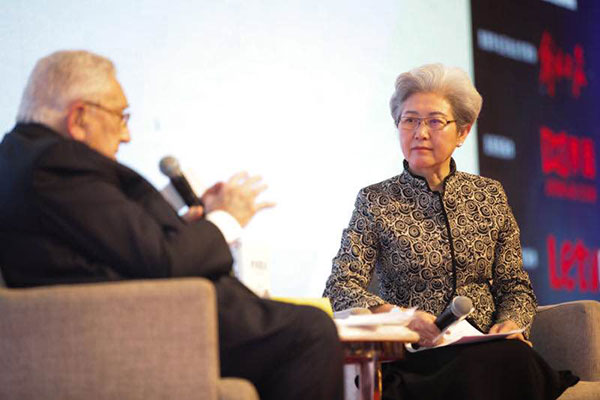
Fu Ying and Kissinger talk in a forum themed "World Order and China's Role" in Beijing on Saturday. [Photo provided to china daily.com.cn] |
Since the beginning of 2016, the United States has made two notable comments in relation to China.
First, in his 2016 State of the Union address, US President Barack Obama, who has always been rather discreet, said in a rather high-profile manner, "The United States of America is the most powerful nation. Period. It's not even close."
Second, after the Taiwan leader election, US officials repeated the one-China policy while expressing concerns over cross-Straits stability.
These two things suggest that the US remains confident in its own strength, and military confrontations to pin down Chinese development and stability are not part of the US' strategic considerations.
Instead, the US regards economic competition as the primary area of competition between the US and China for global leadership.
In international-trade rulemaking, the US kept one step ahead of China by successfully inking the Trans-Pacific Partnership Agreement negotiations with 11 countries on Feb 4. For China, the free-trade agreements signed with the Republic of Korea on June 1 and Australia on June 17 helped create two major breaches in the wall of US-made trade rules.
In international finance and trade, the two countries also had their own respective gains. As the US economy continues to improve, the international status of the US dollar has been further consolidated, with substantial increases in the exchange rate against major currencies, including the RMB. Meanwhile, the Chinese manufacturing industry has shown remarkable international competitiveness.
In the area of domestic economic or national strength development, an important area of China-US competition, the US has performed better. The Obama administration's policy of bringing manufacturing back to the US has produced visible results, leading to effective technological progress, a steady increase in employment and an appreciating dollar.
In contrast, the domestic economic situation in China has worsened, with aggravated capacity excesses, more companies forced out of business and increased debts for local governments, leading to substantial financial and macroeconomic pressure.
The once widely publicized "Beijing Consensus" or "China Model"-of government-led development and an industrial structure shaped by government investment-was objectively challenged, and the model faces readjustment. And the US experience in economic governance has attracted increasing attention from China.
At the end of October 2015, Chinese media intensively reported on US surveillance planes flying over China's territorial waters around the Nansha Islands in the South China Sea, causing an uproar in China over the violation of Chinese sovereignty.
There was widespread suspicion in China that the US was deliberately provoking military frictions to tie down China' stable development. It was against this backdrop that the US issued a statement on adhering to the one-China principle and hoping for cross-Straits peace and stability, which helped mitigate suspicions in China and further testified to the US' intention to engage in competition with China mainly in the economic field.
The competition between the two countries is competition over international strategy and policy only to a certain extent. In the final analysis, it is competition over overall national strength, economic strength in particular. The economic focus of China-US competition has had a positive influence on industrial technological progress throughout the world and will help the two countries develop competitive cooperation and China to readjust and reform its domestic policies.
The author is a scholar at the Chinese Academy of Social Sciences. chinausfocus.com


I’ve lived in China for quite a considerable time including my graduate school years, travelled and worked in a few cities and still choose my destination taking into consideration the density of smog or PM2.5 particulate matter in the region.
Copyright 1995 - . All rights reserved. The content (including but not limited to text, photo, multimedia information, etc) published in this site belongs to China Daily Information Co (CDIC). Without written authorization from CDIC, such content shall not be republished or used in any form. Note: Browsers with 1024*768 or higher resolution are suggested for this site.
License for publishing multimedia online 0108263 Registration Number: 130349