 |
|
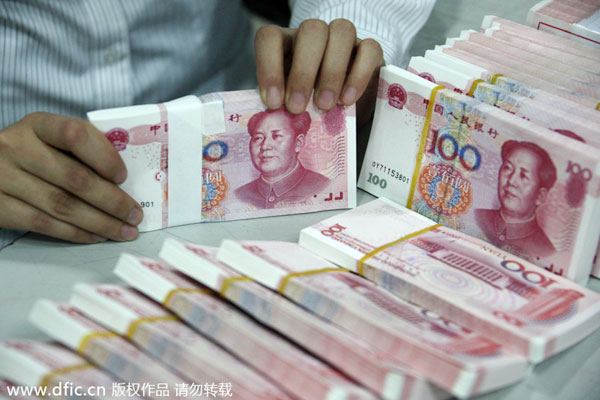
A clerk counts yuan bills at a bank in Huaibei, East China's Anhui province. [Photo/IC] |
Standard & Poor's (S&P) downgrade followed a similar measure earlier in March by Moody's, another major ratings agency. S&P did maintain the rating AA-, adding that China's reform agenda is on track, though likely to proceed more slowly than expected.
Nonetheless, the downgrade was strongly criticized by Chinese officials and media outlets. As a Xinhua commentary put it, China's economic growth is decelerating amid a painful transition. However, a downgrade of outlook is not warranted as "the fundamentals of the Chinese economy remain sound and solid, and are improving."
Was the downgrade warranted?
Rising criticism against credit agencies
Credit rating agencies (CRAs) assign credit ratings, which rate a debtor's ability to pay back debt by making timely interest payments as well as the likelihood of default. The issuers include companies, special purpose entities, non-profit organizations, but also sovereign nations, state and local governments.
In the past two decades, the criticism of the leading CRAs has increased in the advanced economies, starting with the internet burst of 2000-2001, the subprime mortgage crisis after 2005, the global financial crisis in 2008-9 when hundreds of billions of securities that had the CRAs' highest ratings were downgraded to junk, and the European sovereign debt crisis since spring 2010 when Brussels blamed rating downgrades for crisis escalation.
From huge energy companies, such as Enron, to Wall Street's financial giants, the credit agencies - so it seems - have looked the other way, when the world's largest financial conglomerates have engaged in excessive risk-taking.
As the major advanced economies no longer fuel global growth, large emerging economies - China, India, Russia and Brazil, among others - play an increasing role in these prospects. In these economies, criticism against the large ratings agencies has also increased since the Asian financial crisis of 1997-98 and the recent downgrades, which reflect substantial capital outflows and other challenges.
In advanced economies, criticism focuses on the CRAs' professional conduct. In emerging and developing economies, it also addresses the issue of fairness. As the past two decades suggest, the CRAs are not immune to professional biases, moral hazards and conflicts of interests. According to critics, the problem stems from the extraordinary concentration of the CRA industry.
The global might of the "Big Three"
According to influential reports in the early 2010s, the two largest U.S.-based CRAs - S&P and Moody's - controlled some 80 percent of the global market share. In turn, the "Big Three" - S&P, Moody's plus Fitch Ratings, which is dually headquartered in the U.S. and the U.K. and majority-owned by a French holding company - dominate 95 percent of the ratings business across the world. Not only is the industry concentrated, so is their geography.
In both advanced and emerging economies, governments borrow money by issuing government bonds and selling them to private investors, overseas or domestically. However, emerging and developing economies enjoy neither the history of capital accumulation nor the high living standards that most advanced economies take for granted. Consequently, their efforts to borrow are far more challenging and constrained.
Yet, current credit ratings are based on advanced-economy CRAs' perceptions of a sovereign's ability and willingness to repay its debt. Of course, emerging and developing economies can seek funds from international multilateral organizations, such as the World Bank and the International Monetary Fund. However, the latter reflect the interests of their primary owners in advanced economies, which select their leaders, set their policies and control enforcement.
It is precisely for this reason that emerging economies led by China have recently established new alternatives, such as the BRICS New Development Bank (NDB) and the Asian Infrastructure Investment Bank (AIIB), which stress borrowing in the emerging and developing world.
Nevertheless, the "Big Three" continue to dominate the ratings business.


I’ve lived in China for quite a considerable time including my graduate school years, travelled and worked in a few cities and still choose my destination taking into consideration the density of smog or PM2.5 particulate matter in the region.

Copyright 1995 - . All rights reserved. The content (including but not limited to text, photo, multimedia information, etc) published in this site belongs to China Daily Information Co (CDIC). Without written authorization from CDIC, such content shall not be republished or used in any form. Note: Browsers with 1024*768 or higher resolution are suggested for this site.
License for publishing multimedia online 0108263 Registration Number: 130349