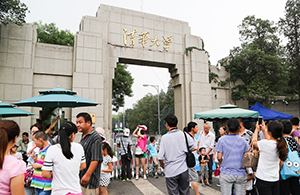
Braced for bedlam I'd seen in other Asian cities, I was pleasantly surprised by the much more user-friendly transport in Beijing
Not quite sure what my preconceptions were, but one impression has been shattered - favorably, I might add.
Preparing for my first trip to Beijing, I was prepared, based on my previous experience of Asian cities, for teeming, jostling hordes, chaotic traffic, and - for a foreign visitor - completely incomprehensible mass transit systems.
Well, this past week I have been proved wrong on many counts, above all about the metro system.
Getting a card loaded with enough RMB to last you at least a week is child's play.

Using it to enter the system is child's play.
And provided you have sussed out your journey with the aid of a metro system map, getting the right train is child's play. Plus, there seem to be attendants at every turn to direct you. (London Underground chiefs, please note).
Because here's the good bit. All the stations are labeled in Chinese and Roman script on maps, and once you've picked which line and boarded your train, a helpful sign above the doors illuminates with a green light for the next station, and a soothing female voice alerts you just before arrival, and again on arrival, to the station in Mandarin and English. (Again, London Underground chiefs, please note!)
One slightly negative note. The authorities have turned making the station entrances anonymous into an art form.
I walked past my local station at Huixinxijie Nankou on April 24 twice before realizing that the drab, gray building that looked like an electricity substation was in fact the entrance to the metro system. No doubt it's easier for locals. The name wasn't exactly emblazoned over the entrance.
And I can't put my finger on it, but the anonymity of the subway system's logo doesn't help when trying to find your station. London has its famous red circle with the word Underground written across it. Paris has its instantly recognizable M, usually atop some art deco style ironwork, while Moscow's underground rail system stations sport a huge, distinctive red letter M.
I'm not looking at this through rose-tinted spectacles - my first Beijing subway trip was at the height of the rush hour. It wasn't unpleasant, and we were all happy in the knowledge that we were dodging the undoubted traffic jams above our heads.
So now to the collapse of my next preconception.
Beijing is, like Manhattan, laid out in a logical grid pattern, with broad four-lane boulevards, which somehow lessen the impact of the towering steel and glass skyscrapers. Certainly you feel less claustrophobic than in, say, downtown New York City or London's central financial district.
Plus, it's much greener than I thought it would be. Trees line many of the boulevards, and there's grass and shrubs everywhere. One slightly bizarre note - on a patch of real grass near my office someone has carefully filled in a bare patch with plastic AstroTurf. Nice touch.
I suspect, however, that the broad boulevards may be the city's undoing when it comes to traffic.
As a Chinese friend pointed out not long after my arrival, China's blooming middle class has come late to mass car ownership. Two or three decades ago, it would have been a bicycle or a scooter.
Now the object of desire is a locally built Audi, BMW or Honda, or its Chinese designed and built equivalent.
You can see the results of that boom on every street, where parking is at a premium.
Traffic jams seem to occur at every major road junction, where any semblance of order seems to disappear. I'm told that the route out to the airport is almost permanently backed up because of a series of ill-designed junctions en route.
Which brings me to taxis. They are remarkably cheap - 13 yuan ($2; 1.8 euros) at flagfall, and 2.60 yuan per kilometer thereafter.
Provided you can show the driver your destination written in Chinese or point it out on a map, it's fine. Few, if any, speak any English - fair enough, as London isn't exactly littered with Mandarin-speaking cabbies.
There is, however, a catch.
I took a taxi from my apartment block to Tian'anmen Square - a must when you are in Beijing - and it cost me an eminently reasonable 20 yuan, no tip needed.
When I came out to head home, I jumped into a taxi - identical in color to others - to find it had no meter, and the driver demanded 100 yuan for the journey back, no haggling.
To this day, I can't work out if it was a cowboy cab, or just one I hadn't been told about.
Life in Beijing is a learning curve.
The author is managing editor of China Daily European Weekly, based in London.
Contact the writer at chris@mail.chinadailyuk.com


I’ve lived in China for quite a considerable time including my graduate school years, travelled and worked in a few cities and still choose my destination taking into consideration the density of smog or PM2.5 particulate matter in the region.
Copyright 1995 - . All rights reserved. The content (including but not limited to text, photo, multimedia information, etc) published in this site belongs to China Daily Information Co (CDIC). Without written authorization from CDIC, such content shall not be republished or used in any form. Note: Browsers with 1024*768 or higher resolution are suggested for this site.
License for publishing multimedia online 0108263 Registration Number: 130349