 |
|
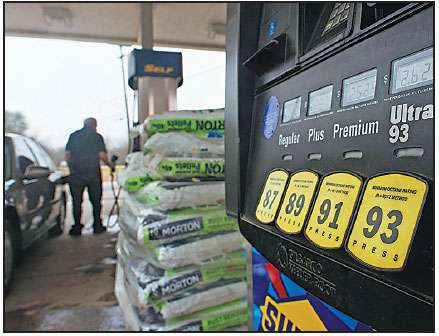
The price of fuel is seen on a pump at a gas station in Rockbridge, Ohio, Oil companies' cuts in gasoline prices have yet to be offset by greater retail spending in the United States. [Photo/Agencies] |
Thanks to fear mongering on the US presidential campaign trail, the trade debate and its impact on American workers is being distorted at both ends of the political spectrum. From China-bashing on the right to the backlash against the Trans-Pacific Partnership on the left, republicans and Democrats both have mischaracterized foreign trade as the United States' greatest economic threat.
In 2015, the US had trade deficits with 101 countries — a multilateral trade deficit in the jargon of economics. But this cannot be pinned on one or two "bad actors", as politicians invariably put it. Yes, China — everyone's favorite scapegoat — accounts for the biggest portion of this imbalance. But the combined deficits of the other 100 countries are even larger. What the presidential candidates won't tell the American people is that the trade deficit and the pressures it places on hard-pressed middle-class workers stem from problems made at home. In fact, the real reason the US has such a massive multilateral trade deficit is that Americans don't save.
Total US saving — the sum total of the savings of families, businesses and the government sector — amounted to just 2.6 percent of the national income in the fourth quarter of 2015. That is a 0.6 percentage point drop year-on-year and less than half the 6.3 percent average that prevailed during the final three decades of the 20th century.
Any basic economics course stresses the ironclad accounting identity that savings must equal investment at each and every point in time. Without savings, investing in the future is all but impossible. And yet that's the position in which the US currently finds itself. Indeed, the savings numbers cited above are "net" of depreciation — meaning that they measure the saving available to fund new capacity rather than the replacement of worn-out facilities. Unfortunately, that is precisely what the US is lacking.
So why is this relevant for the trade debate? In order to keep growing, the US must import surplus savings from abroad. As the world's greatest economic power and issuer of what is essentially the global reserve currency, the US has had no trouble — at least not yet — attracting the foreign capital it needs to compensate for the big shortfall in domestic savings.
But there is a critical twist: To import foreign savings, the US must run a massive international balance-of-payments deficit. The mirror image of the US' savings shortfall is its current-account deficit, which has averaged 2.6 percent of GDP since 1980. It is this chronic current-account gap that drives the multilateral trade deficit with 101 countries. To borrow from abroad, the US must give its trading partners something in return for their capital: US demand for products made overseas.
Therein lies the catch to the politicization of the US' trade problems. Closing down trade with China, as Republican presidential hopeful Donald Trump would effectively do with his proposed 45 percent tariff on Chinese products sold in the US, would backfire. Without fixing the savings problem, the Chinese share of the US' multilateral trade imbalance would simply be redistributed to other countries — most likely to higher-cost producers.
I have estimated that Chinese labor compensation rates remain far less than half of those prevailing in the US' other top-ten foreign suppliers. If those countries were to fill the void left by a penalty on China, like the one Trump has proposed, higher-cost producers would undoubtedly charge more than China for products sold in the US. The resulting increase in import prices would be an effective tax hike on the American middle class. That underscores the futility of attempting to find a bilateral solution for a multilateral problem.
The same perverse outcome could be expected from the reckless fiscal policies proposed by other politicians. Take, for example, the 10-year $14.5 trillion federal government spending binge proposed by Democratic presidential candidate Bernie Sanders — a program judged to be without any semblance of fiscal integrity by leading economic advisers within the very party whose nomination he seeks.
Government budget deficits have long accounted for the largest share of the US' seemingly chronic savings shortfall. The added deficits of "Sandersnomics", or for that matter those of any other politician, would further depress the US' national savings — thereby exacerbating the multilateral trade imbalance that puts such acute pressure on middle-class families.
Seen through the same lens, mega trade deals, such as the Trans-Pacific Partnership, would also have an important bearing on pressures that squeeze American workers. The TPP would effectively divert trade flows from those countries that are not a part of the agreement to those that are. With China excluded from the TPP, the same phenomenon noted above would result: American middle-class families would be taxed by the diversion of trade away from low-cost non-TPP producers such as China toward higher-cost TPP signatories such as Japan, Canada and Australia.
In short, trade bashing is a foil for the vacuous promises that politicians of both parties have long made to American voters. Savings is the seed corn of economic growth — the means to boost American competitiveness by investing in people, infrastructure, technology and new manufacturing capacity. The US government, through decades of deficit spending and advocacy of policies that encourage households to consume rather than save, has forced the US to rely on foreign savings for far too long. This has undermined US competitiveness, punishing workers with the job losses and wage compression that trade deficits invariably spawn.
The US' 101 trade deficits don't exist in a vacuum. They are a symptom of a deeper problem: a US economy that has lived beyond its means for decades. Savings is but a means to an end — in this case the sustenance of a thriving and secure middle class. Without savings, the American Dream is in danger of becoming a nightmare. The trade debate of the current presidential campaign heightens that risk.
The author, a faculty member at Yale University and former Chairman of Morgan Stanley Asia, is the author of Unbalanced: The Codependency of America and China.


I’ve lived in China for quite a considerable time including my graduate school years, travelled and worked in a few cities and still choose my destination taking into consideration the density of smog or PM2.5 particulate matter in the region.
Copyright 1995 - . All rights reserved. The content (including but not limited to text, photo, multimedia information, etc) published in this site belongs to China Daily Information Co (CDIC). Without written authorization from CDIC, such content shall not be republished or used in any form. Note: Browsers with 1024*768 or higher resolution are suggested for this site.
License for publishing multimedia online 0108263 Registration Number: 130349