 |
|
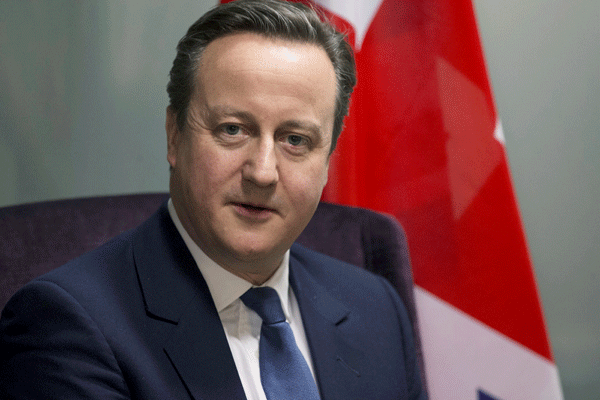
British Prime Minister David Cameron attends meeting with Irish Prime Minister Enda Kenny during a European Union leaders summit addressing the talks about the so-called Brexit and the migrants crisis, in Brussels, Belgium, February 19, 2016. [Photo/Agencies] |
Those campaigning for the United Kingdom to exit the European Union claim that doing so would make their country both freer and richer. They assert that after the so-called Brexit, the UK could quickly negotiate a bespoke agreement with the EU that offers all the benefits of free trade without the costs of EU membership; strike better trade deals with other countries; and reap huge benefits from scrapping burdensome EU regulations. This is a delusion.
In fact, Brexit would entail huge economic costs for the UK. The uncertainty and disruption of drawn-out and doubtless acrimonious divorce proceedings would depress investment and growth. Permanent separation would reduce trade, foreign investment and migration, and hurt competition, productivity growth and living standards. And a divorce would deprive the UK of influence over future EU reforms-notably, the completion of the single market in services-from which it would benefit.
The London School of Economics' Centre for Economic Performance calculates that the long-term costs to the UK of lower trade with the EU could be as high as 9.5 percent of its GDP, while the fall in foreign investment could cost 3.4 percent of its GDP or more. Those costs alone dwarf the potential gains. The UK's net contribution to the EU budget amounted to only 0.35 percent of its GDP last year, and scrapping EU regulation would bring limited benefits, because the UK's labor and product markets are already among the freest in the world.
The exit process would generate prolonged uncertainty. Officially, it is meant to take two years. But it would probably take much longer. Moreover, any agreement on a new economic relationship with the UK would require unanimity among the EU's 27 remaining members. And the UK would also have to renegotiate-from scratch-the 50-plus trade deals that the EU has with other countries. All this would take time.
In the meantime, the UK's trading rules and domestic regulations would be up in the air. Investment and employment decisions would be postponed or canceled. The pound would plummet. The foreign investors financing Britain's current-account deficit-which hit 7 percent of its GDP in the final quarter of last year-might drive up the risk premium on UK assets or, worse, pull out. All of that would weaken economic growth, jeopardizing the government's fiscal plans.
Brexit supporters claim that Britain could strike its own special deal with the EU, cherry picking the provisions it likes. The UK would have the whip hand, they argue, because it buys more from the EU than it sells in return. But this, too, is a delusion. The US also has a trade deficit with the EU, yet it doesn't get to dictate terms in the negotiations over the Transatlantic Trade and Investment Partnership. Moreover, exports to the EU matter more to the UK than exports to Britain do to the EU.
In short, the EU would call the shots-and doubtless be tough with the UK. Many economic actors-from German car manufacturers to French farmers to financial centers around the EU-would want to hamper their British competitors. For their part, EU governments would want to punish Britain, not least because they know that a velvet divorce with Britain would bolster anti-EU parties, such as France's far-right National Front, which has already called for a referendum on EU membership.
New trade deals with non-EU countries would also probably involve worse terms for the UK. While the UK wouldn't be hamstrung by protectionist interests in the EU, its smaller economy, largely open markets, and desperation for deals would weaken its clout. Indeed, the US has stated that it has no immediate interest in negotiating a trade deal with the UK.
Thinking through all the economic implications of a Brexit is complicated. But the bottom line is simple: Leaving the EU would make Britain much worse off.
The author, a former economic adviser to the president of the European Commission, is a visiting senior fellow at the London School of Economics' European Institute and the author of European Spring: Why Our Economies and Politics are in a Mess-and How to Put Them Right.
Project Syndicate


I’ve lived in China for quite a considerable time including my graduate school years, travelled and worked in a few cities and still choose my destination taking into consideration the density of smog or PM2.5 particulate matter in the region.
Copyright 1995 - . All rights reserved. The content (including but not limited to text, photo, multimedia information, etc) published in this site belongs to China Daily Information Co (CDIC). Without written authorization from CDIC, such content shall not be republished or used in any form. Note: Browsers with 1024*768 or higher resolution are suggested for this site.
License for publishing multimedia online 0108263 Registration Number: 130349