 |
|
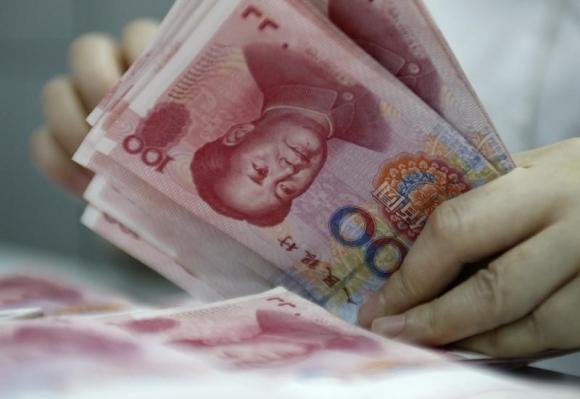
An employee counts yuan banknotes at a bank in Huaibei, Anhui province June 22, 2010.[Photo/Agencies] |
There is a growing awareness that financial markets are beyond the control of national policymakers in today's globalized world. While a few economies do have the scale to shape interconnected global markets, they face serious constraints, political and economic. As a result, the global economy is stuck in a pro-cyclical financial cycle, with few options for escape.
As Claudio Borio pointed out years ago, the global financial cycle is longer than real economic cycles, and is closely associated with the fluctuating value of the dominant reserve currency, the US dollar. When the dollar is weak, capital flows from the United States to other countries, where it spurs growth through increased credit.
Unfortunately for these countries, typically in the emerging world, the inflows also spur inflation, asset bubbles and currency appreciation. The result is growing financial and geopolitical risks, which make the US dollar more appealing for investors. As capital then flows back to the US, the dollar gains strength, while emerging economies are left to face the consequences of bursting asset bubbles and currency devaluation.
In a zero-interest-rate world, a strong dollar plays the same deflationary role in global markets as the gold standard did during the 1930s. The US is thus the economy that is best equipped to pull the world out of secular deflation. But that requires a willingness to resolve the so-called Triffin dilemma-the conflict between long-term international interests and short-term domestic interests that issuers of reserve currencies confront-by running increasingly large current-account deficits that enable the US to meet global demand for liquidity.
This seems unlikely, not only for the US, but also for its reserve-issuing counterparts in the rest of the advanced world. Stagnant economic growth and high debt burdens in Europe and Japan have destroyed politicians' will to raise taxes or borrow more to create space for fiscal expansion. As a result, monetary policy throughout the developed world has become severely overburdened.
The problem today is a lack of will, not a lack of opportunities, to do what it takes to boost demand. In fact, investment in global public goods-namely, the infrastructure needed to meet the needs of the developing world and to mitigate climate change-could spur global reflation. An estimated $6 trillion in infrastructure investment will be needed annually over the next 15 years just to address global warming. Moreover, it has been estimated that an additional $7.1 trillion in annual investment by the nine top economies-which account for 60 percent of the world output-will be needed to sustain moderate global growth.
With the US, the issuer of the world's preeminent reserve currency, unwilling or unable to provide the liquidity needed to close the infrastructure investment gap, a new supplementary reserve currency should be instituted-one whose issuer does not have to confront the Triffin dilemma. There is only one option for this: the International Monetary Fund's Special Drawing Right.
Of course, the road to becoming a reserve currency is long, especially for the SDR, which currently functions only as a reserve asset, with an issuance size ($285 billion) that is small relative to global official reserves of $10.5 trillion (excluding gold). But an incremental expansion of the SDR's role in the new global financial architecture, aimed at making the monetary-policy transmission mechanism more effective, can be achieved without major disagreement.
In the past, the financial resources available for investment were constrained by national savings. In recent years, however, unconventional monetary policy has shown that liquidity and credit can be created against global savings, with relatively little impact on inflation, provided there is excess capacity in production and insufficient effective aggregate demand.
The IMF and the major central banks should take advantage of this newfound knowledge, and provide equity and liquidity against long-term lending for infrastructure investments. In this way, global public goods can be not only funded; they can also propel global recovery.
Andrew Sheng is distinguished fellow of the Asia Global Institute at the University of Hong Kong and a member of the UNEP Advisory Council on Sustainable Finance. Xiao Geng, director of the IFF Institute, is a professor at the University of Hong Kong and a fellow at its Asia Global Institute.


I’ve lived in China for quite a considerable time including my graduate school years, travelled and worked in a few cities and still choose my destination taking into consideration the density of smog or PM2.5 particulate matter in the region.
Copyright 1995 - . All rights reserved. The content (including but not limited to text, photo, multimedia information, etc) published in this site belongs to China Daily Information Co (CDIC). Without written authorization from CDIC, such content shall not be republished or used in any form. Note: Browsers with 1024*768 or higher resolution are suggested for this site.
License for publishing multimedia online 0108263 Registration Number: 130349