 |
|
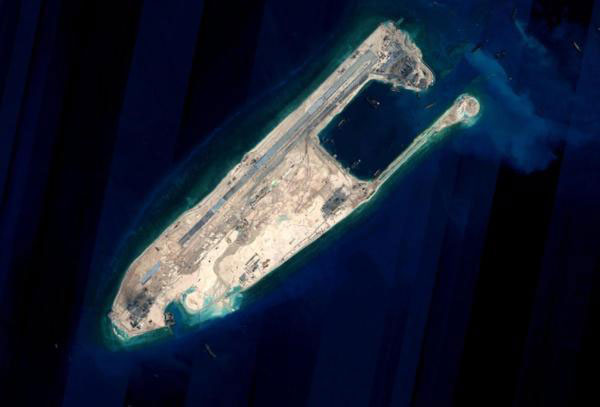
This satellite image shows the Yongshu Jiao of China's Nansha Islands. [Photo/Xinhua] |
The South China Sea arbitration case initiated by the Philippines in 2013 is being watched closely by the international community as the court's ruling may be announced before the end of June.
Whatever the outcome, the case, which aims to overrule Beijing's time-honored legal interests in the South China Sea, ranging from navigation and fishing to administrative management, is built on shaky legal ground.
To begin with, the issue of territorial sovereignty is beyond the scope of the UN Convention on the Law of the Sea, thus the Permanent Court of Arbitration in The Hague has no jurisdiction over the case, since in essence it is concerned with territorial sovereignty over several maritime features in the South China Sea.
Turning a blind eye to the fact that Chinese people first discovered, named, and developed the reefs and islets in the waters, as well as the Chinese government's consistent jurisdiction over these islands, Manila instead bases its claims on written evidence taken out of context.
For example, it claimed that Xisha Islands are the south end of Chinese territory, "according to" an official document issued by the Chinese government in 1937. But the truth is, this refers to comments by some geographical experts that are later refuted in the document.
The Philippine government keeps ignoring the abundant evidence against its arbitration, and claims China neither named any islands in the South China Sea before 1947 nor extended its fisheries to the waters.
Yet, as a popular sailing guide called Geng Lu Bu records, Chinese fishermen fished there in the Ming and Qing dynasties between the 14th and 20th century, and dozens of islands in the South China Sea already had their Chinese names. Many of these names, including Subi Reef and Namyit Island, have been widely adopted and used by international sailors until now.
Despite Manila's repeated smear attempts, such as confounding Xisha Islands and Nansha Islands with some Vietnamese islets, China's sovereignty in the South China Sea has been explicitly reflected in the world maps issued by countries such as Japan, France, even Vietnam, in the aftermath of World War II.
Worse still, the Philippines has even gone further and challenged the one-China principle, which was enshrined in Beijing-Manila diplomatic relations, arguing that Taiwan's presence in the South China Sea after 1949 has nothing to do with China's territorial interests there.
Such distortion, which seeks to nullify Taiwan's routine cruises and civil development in the waters near Nansha Islands since the 1950s, not only violates its diplomatic commitment to China but also infringes upon the country's irrefutable sovereignty in the South China Sea.
But no matter how hard Manila tries to invalidate Beijing's legal territorial claims by overstating the "evidence" provided by a selected few scholars, its efforts will only prove futile in the face of history written by all navigators who traveled across the South China Sea.
The author is a researcher at the National Institute for South China Sea Studies, Hainan province.


I’ve lived in China for quite a considerable time including my graduate school years, travelled and worked in a few cities and still choose my destination taking into consideration the density of smog or PM2.5 particulate matter in the region.
Copyright 1995 - . All rights reserved. The content (including but not limited to text, photo, multimedia information, etc) published in this site belongs to China Daily Information Co (CDIC). Without written authorization from CDIC, such content shall not be republished or used in any form. Note: Browsers with 1024*768 or higher resolution are suggested for this site.
License for publishing multimedia online 0108263 Registration Number: 130349