 |
|
LI FENG/CHINA DAILY |
US President Barack Obama is expected to pay a visit to Hiroshima on Friday during the G7 summit in Japan, but he has said he will not be apologizing for the atomic bombing of the Japanese city during World War II.
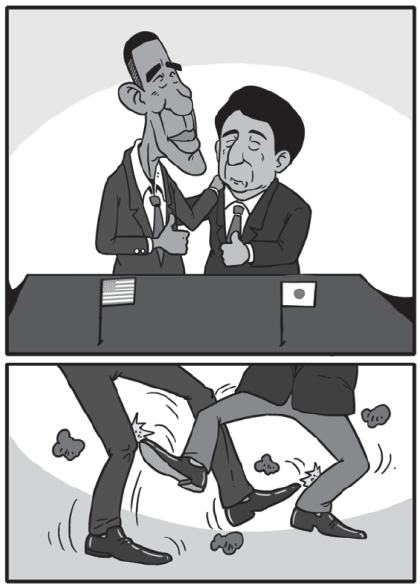
Such a statement is crystal-clear proof that sharp contradictions and differences exist between the United States and Japan under the cloak of their intimate cooperation, and these appear even more evident if the bargaining and concessions between the two countries on the event's venue and Obama's agenda in Japan are considered.
Under Japan's unremitting efforts, Obama did agree to visit Hiroshima, but his refusal to make an apology for the US' bombing of the city indicates that any US concessions are built on the precondition that none of its own principles are breached.
Despite its subjection to the US, Japan actually holds a particularly complicated mentality toward the US. Japan owes thanks to the US, because its "democratic reformation" under the domination of the US helped it embark on a road toward economic prosperity after World War II. However, Japan is also psychologically opposed to the "pervasive influence" of Washington.
Japan admires the US for its powerful strength in various fields, but also feels resentful at the US for its dropping of atomic bombs on Hiroshima and Nagasaki, which caused huge casualties. At the same time, Japanese people are very averse to the US' actual political control of their country. The wide-spread sympathy and support the Japanese public extends to local residents in Okinawa in their calls for the departure of US troops stationed there is a kind of epitome of Japanese people's antipathy toward the US.
For its part, the US also does not look forward to a very powerful Japan. A strong Japan will result in the qualitative transformation of US-Japan relations from the current "leading and being led" and "cooperation existing with competition" to "potentially and actually hostile" and "mutual competition".
Against the backdrop of the continuous rise in China's national strength, the US has also changed its Japan policy from the past "demilitarization" and "excessive restrictions" to "rearmament of Japan" in a bid to use a powerful Japan to balance China's rise. However, the US is still wary of an excessively powerful Japan. The US has so far not allowed Japan to develop its own nuclear weapons, build its own real aircraft carrier or allow Japan to posses its long-range missiles. The US actually holds more fears about Japan than China and is more vigilant toward it.
What the US' pro-Japan policy pursues is using Japan to balance China's influence rather than genuinely fostering a powerful Japan. But the US also does not want to see China's collapse, because it knows that a China built on Confucianism and the tradition of advocating "peace, courtesy and tolerance" will not pose a real threat to the US and the world.
Hence, the endless tussle in which China and Japan have become stuck best serves the interests of the US. The US also has full knowledge of Japan's innermost mind, knowing that any strategy aimed at containing China will easily motivate Japan's support and participation, as indicated by the US' encouragement of Japan joining the Trans-Pacific Partnership Agreement and Japan's acceptance without hesitation, ignoring the fact that the TPP is likely to have negative influences on its domestic industries.
Compared with Japan, the US has a grander and longer-term world strategy. This best explains that while agreeing to pay a visit to Hiroshima at the invitation of Japan on the sidelines of the G7 summit, Obama has firmly adhered to the US principle and will not apologize for the atomic bombs dropped on the two Japanese cities during World War II. But the visit saves face for the Japanese government while increasing Japan's dependence on the US and motivating it to continue playing its role in balancing China in East Asia. Despite lacking an apology from the US government, Obama's visit to Hiroshima, however, can still be regarded as a diplomatic victory in the eyes of Japan's Shinzo Abe government, because the move will reinforce Japan's image as a "wartime victim".
The author is a professor on Japan studies at China Foreign Affairs University.


I’ve lived in China for quite a considerable time including my graduate school years, travelled and worked in a few cities and still choose my destination taking into consideration the density of smog or PM2.5 particulate matter in the region.
Copyright 1995 - . All rights reserved. The content (including but not limited to text, photo, multimedia information, etc) published in this site belongs to China Daily Information Co (CDIC). Without written authorization from CDIC, such content shall not be republished or used in any form. Note: Browsers with 1024*768 or higher resolution are suggested for this site.
License for publishing multimedia online 0108263 Registration Number: 130349