 |
|
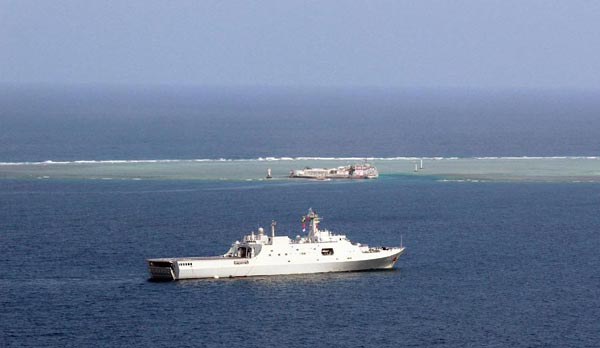
A formation of the Nanhai Fleet of China's Navy on Saturday finished a three-day patrol of the Nansha islands in the South China Sea. [Photo/Xinhua] |
The United States and some of its allies are using international forums to sensationalize the South China Sea disputes, especially the arbitration case initiated by the Philippines in January 2013.
Although China rejected the notice of arbitration by the Philippines in February 2013 and made it clear that China will neither accept nor participate in the arbitration, the Philippines handed in a request for arbitration to the Hague-based Permanent Court of Arbitration in March 2014 with 15 submissions.
Despite China's strong opposition, the arbitral tribunal announced in late October 2015 that it can judge on seven of the 15 submissions, and linger over some other submissions.
However, the truth is that the arbitral tribunal has no jurisdiction over this case according to international law.
China's 2006 Declaration on Optional Exceptions made in accordance with Article 298 of the UN Convention on the Law of the Sea, clearly excludes disputes on maritime delimitation from compulsory arbitration.
At the heart of the disputes between China and the Philippines is the latter's illegal occupation of Chinese reefs and islets in the South China Sea. Categorizing maritime features is in essence subject to territorial sovereignty, which is beyond the scope of UNCLOS. Hence the arbitral tribunal has accepted submissions over which it does not have jurisdiction in the first place.
Manila claims China's Meiji Reef, Ren'ai Reef, and Zhubi Reef are low-tide elevations that can't claim territorial sea, an exclusive economic zone or continental shelf. However, to judge whether a maritime feature is an island, reef or low-tide elevation is an inseparable part of territorial sovereignty. Terra nullius is not entitled to any maritime rights, so it will be nonsense to discuss the maritime rights of a feature if the sovereignty is not made clear first.
That the arbitral tribunal has turned a blind eye to the Philippines' self-evident attempt to muddle the issue constitutes an abuse of power that may deal a blow to its credibility in settling international disputes under the Convention.
As for their disputes over maritime delimitation in the South China Sea, Beijing has repeatedly informed Manila that it will not accept the arbitration case in accordance with Article 298 of the Convention. Should the court's ruling touch upon relevant appeals by Manila, such as the one including Meiji Reef and Ren'ai Reef as part of its continental shelf and exclusive economic zone, the arbitral tribunal will inevitably be judging on the sovereignty of the islands and reefs involved in this case. Should the arbitral tribunal make a judgment on this, it would in fact not only arbitrate the sovereignty of the Meiji Reef and Ren'ai Reef, but also delimitate the seas of China and the Philippines. However, any territorial dispute is far beyond the arbitral tribunal's jurisdiction. The Chinese government has consistently called for candid negotiations with the Philippines, which is in line with several bilateral agreements between the two countries, as well as the Declaration on the Conduct of Parties in the South China Sea signed by China and ASEAN countries in 2002.
In other words, Manila has failed to fulfill its commitment to rule-based dispute management, and placed a ticking time bomb in regional stability. The arbitral tribunal is conniving in the Philippine's attempt to violate agreements.
The final ruling, if it's a result of well-orchestrated misinterpretation of international laws including UNCLOS, will inject more uncertainties into the regional order and serve as an unwanted precedent that may "inspire" other countries to take articles out of context while dealing with similar maritime disputes.
China has every reason to dismiss the unlawful arbitration case.
The author is deputy director of the China Institute for Marine Affairs attached to the State Oceanic Administration.


I’ve lived in China for quite a considerable time including my graduate school years, travelled and worked in a few cities and still choose my destination taking into consideration the density of smog or PM2.5 particulate matter in the region.
Copyright 1995 - . All rights reserved. The content (including but not limited to text, photo, multimedia information, etc) published in this site belongs to China Daily Information Co (CDIC). Without written authorization from CDIC, such content shall not be republished or used in any form. Note: Browsers with 1024*768 or higher resolution are suggested for this site.
License for publishing multimedia online 0108263 Registration Number: 130349