 |
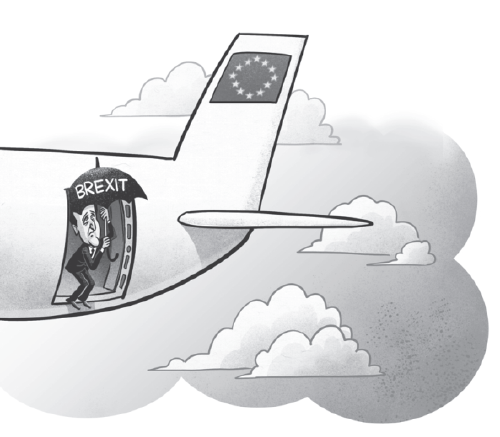
| Luo Jie / China Daily |
The "Brexiteers"-those who want Britain to leave the European Union-argue that their goal would be virtually cost-free and have no effect on the United Kingdom's global trade. They are wrong.
Start with the basics. Leaving the EU means that the UK would exit the EU's Customs Union, which is the basis for cross-border free trade among the EU's 28 members. It also means exit from the Single Market-the basis for the free movement of goods and services among EU members. By definition, non-members of the EU cannot belong to the Single Market.
So what would happen next? During the two-year period before Britain's withdrawal takes final effect, there would be UK-EU negotiations on many points-sovereignty, the legal order, immigration, finances and economic matters. The assumption is that a crucial goal for Britain would be to negotiate a trading relationship as close as possible to the free-trade relationships that exist today.
That is easier said than done. The best result would be if all players agreed to maintain the free trade already achieved, with the UK setting a new external tariff on a duty-free basis, applicable to all comers. This is what happened in the 1970s after Britain and Denmark left the European Free Trade Association: Free-trade agreements were negotiated among EFTA members and between them and the EU (or the European Economic Community as it was then known).
But Brexiteers should realize that there is no guarantee that this would happen again-and, in any case, there would be complications. While this solution would be good for the 45 percent of British exports that are sold in EU markets, it would reduce protection for British industries to zero. Under the rules of the World Trade Organization, the same import duties must be applied to all WTO participants-which means that if Britain's imports from the EU are duty-free, its imports from the rest of the world must be, too.
The alternative would be for British exporters to accept the EU's common external tariff, and for the UK to create its own import tariff, applied to all imports, including from the EU. Because the common tariff is at a relatively low level on industrial and fishery products, this might not be an insuperable barrier for British exports, and it would allow some flexibility in protecting UK companies from imports. The potential pitfall is that any British tariff increase above the EU level would expose the UK to claims for compensation from third countries in the WTO.
The bigger question that the Brexiteers need to answer is how to secure a high level of access to the EU's internal market. This is vitally important for Britain's service industries, particularly for the city of London's exports of financial services.
In the view of many observers, including me, access to the Single Market through the EEA is no longer available. But what if we're wrong? The point is that such a deal would go against all the instincts (and rhetoric) of the Brexiteers, because it would mean accepting the EU's "four freedoms": not just the free movement of goods, services, and capital-but of people, too. That would be hard to square with the Brexit objective of "controlling our borders". The Brexiteers would also blanch at Britain's obligation under an EEA-type agreement to continue contributing to the EU budget.
The final consequence of Brexit is that the UK would lose its free-trade arrangements with third countries under the many trade agreements that the EU has signed since 2000. Replacing these agreements with bilateral deals would take time. There is no guarantee that the EU would agree to an interim continuation of free trade, and it seems certain that British exports would face higher tariffs than its former EU partners in those third countries.
The author is a former deputy director-general at the WTO and a former deputy director-general at the European Commission Directorate-General for Trade.
Project Syndicate


I’ve lived in China for quite a considerable time including my graduate school years, travelled and worked in a few cities and still choose my destination taking into consideration the density of smog or PM2.5 particulate matter in the region.
Copyright 1995 - . All rights reserved. The content (including but not limited to text, photo, multimedia information, etc) published in this site belongs to China Daily Information Co (CDIC). Without written authorization from CDIC, such content shall not be republished or used in any form. Note: Browsers with 1024*768 or higher resolution are suggested for this site.
License for publishing multimedia online 0108263 Registration Number: 130349